
Best New Australian Online Pokies in 2026

New Australian Online Pokies in 2026: Trends and What Players Should Know
The phrase "new pokies" has quietly changed meaning over the past couple of years. It used to describe a fresh title dropped by a slot studio — a new reel set, a new bonus round, nothing structural. Now, when someone searches for the best new Australian online pokies, they’re often asking a bigger question without realising it: which platforms are actually built for how people bank and play in 2026. That’s a question about infrastructure, not graphics.
I spent years on the operations side of gambling platforms, the part where you see how a deposit actually clears versus how the marketing page describes it. What follows is not a hype piece about shiny new game releases. It’s an account of what’s genuinely changed for Australian players choosing where to spend money on pokies this year, and what hasn’t changed no matter what the landing page says.
Why "new" now means "crypto-first"
Australia doesn’t licence domestic online casinos. There are no domestically licensed real-money online casino operators available to Australian players — that’s not a gap in the market, it’s the law working as intended. The Interactive Gambling Act 2001 (IGA), the primary Commonwealth statute governing this space, was built around harm minimisation, and its practical effect is that anyone offering pokies-style casino games to Australians from an Australian licence is breaking the law. So every "new pokies" platform an Australian player finds is, by definition, an offshore one.
With so many new pokies sites launching for Australian players in 2026, it helps to see at a glance how each one stacks up on licensing, bonuses and basic account terms before you sign up.
License: Curacao · Bonus: up to A$2,000 Holds a Curacao license and offers a welcome bonus of up to A$2,000, giving new players a solid starting incentive.
Bonus: 100% up to A$750 + 200 free spins, 35x wagering · Payout speed: crypto 30-120 minutes, fiat 24-72 hours · Min. deposit: A$30 Pairs a matched bonus of up to A$750 plus 200 free spins with fast crypto payouts of 30-120 minutes and a low A$30 minimum deposit, though fiat withdrawals take longer at 24-72 hours.
License: Curacao eGaming (Roby Games Ltd) · Bonus: 100% up to A$750 + 200 free spins Licensed under Curacao eGaming through Roby Games Ltd, with a welcome package of up to A$750 plus 200 free spins.
License: Curacao Gaming Control Board · Bonus: up to A$5,000 + 400 free spins Operates under a Curacao Gaming Control Board license and stands out with a generous welcome offer of up to A$5,000 plus 400 free spins.
License: Curacao Gaming Authority (Jumpman Gaming Ltd) · Bonus: up to A$6,600 + up to 250 free spins across 4 deposits Licensed by the Curacao Gaming Authority under Jumpman Gaming Ltd, offering a large multi-deposit bonus package worth up to A$6,600 plus up to 250 free spins.
License: Curacao eGaming OGL/2023/174/0082 (Dama N.V.) · Bonus: up to A$10,000 + 500 free spins across 4 deposits · Min. deposit: A$15 Licensed under Curacao eGaming via Dama N.V., with a substantial four-deposit bonus reaching up to A$10,000 plus 500 free spins and an accessible A$15 minimum deposit.
License: Curacao, operated by Dama N.V. · Bonus: 325% up to 5.25 BTC + 250 free spins across 4 deposits A Curacao-licensed casino run by Dama N.V., known for a crypto-focused welcome bonus of 325% up to 5.25 BTC plus 250 free spins spread across four deposits.
License: Curacao Gaming Control Board OGL/2023/176/0095 (Hollycorn N.V.) · Bonus: up to A$11,000 + 300 free spins (code NEO100) Licensed by the Curacao Gaming Control Board under Hollycorn N.V., offering a large bonus of up to A$11,000 plus 300 free spins redeemable with a bonus code.
License: Curacao Gaming Control Board OGL/2023/176/0095 (Hollycorn N.V.) · Bonus: up to A$5,000 + 300 free spins across 4 deposits Operating under the same Curacao Gaming Control Board license and Hollycorn N.V. ownership as its sister site, with a four-deposit bonus of up to A$5,000 plus 300 free spins.
License: Curacao (operating since 2017) · Bonus: 250% up to A$2,000 + 50 free spins on the first of six deposits · Min. deposit: A$20 An established Curacao-licensed casino operating since 2017, offering a welcome bonus of 250% up to A$2,000 plus 50 free spins on the first of six deposits, with a A$20 minimum deposit.
That single fact explains most of what’s actually new in 2026. Offshore operators competing for Australian traffic have leaned hard into crypto rails, because crypto is where they can move fastest without depending on the card networks and local banking relationships that are increasingly hostile to gambling transactions. Crypto casinos offer faster banking, wider payment flexibility, and a more direct way to move funds than traditional card-led systems. That’s not a marketing claim, it’s the actual mechanical advantage: a blockchain doesn’t care about your merchant category code the way a bank does.
Bitcoin remains the most widely accepted option across these platforms, but it’s rarely the only one anymore. Most crypto casinos worth using now also support Ethereum, Litecoin, USDT, Dogecoin, Solana, Ripple and a handful of other altcoins. The spread matters less for the pokies themselves — a slot doesn’t care what currency funded the spin — and more for what it says about the operator. A platform that’s only bothered to integrate Bitcoin is usually running older infrastructure. One that’s added five or six chains has generally rebuilt its banking stack more recently, which tends to correlate, loosely, with newer game catalogues too.


Deposits are fast. Withdrawals are where the story splits.
Here’s where I want to be precise, because this is the part every operator’s homepage flattens into a single confident sentence, and it isn’t actually a single story.
On the deposit side, the claim holds up well: crypto casino deposits can be confirmed very quickly, often within minutes. I’ve tested this myself — you send funds, the blockchain confirms, the casino credits the balance, and you’re spinning before a card deposit would have even cleared fraud screening. That part of the "instant crypto" pitch is largely accurate.
Withdrawals are a different animal, and this is where the sources I’ve reviewed genuinely disagree with each other, not just in wording but in substance. One version says withdrawals are usually instant or processed within hours, often clearing in minutes with low fees. Another version says withdrawals depend on casino approval and blockchain processing, which may delay them. Both can be true of the same casino on different days, which is precisely the problem.
Withdrawal delays
The blockchain confirms instantly, but the casino’s internal approval queue can hold up withdrawals for hours or days, meaning you may not receive funds as fast as the network suggests.
The blockchain part of a withdrawal is fast — that’s just how the technology works. The delay, when there is one, almost never comes from the chain. It comes from the casino’s own approval queue: manual review, verification checks, sometimes just an operator sitting on withdrawal requests to manage cash flow. "Instant crypto withdrawals" is a claim about the network. Whether you actually get your money quickly is a claim about the operator’s internal process, and those are two different things being sold as one. Worth knowing before you deposit a meaningful amount.
Provably fair isn’t a slogan, if the casino actually does it
One of the more substantive shifts in newer platforms is the spread of provably fair systems. Reputable crypto casinos use provably fair algorithms that let a player verify the randomness of a result using cryptographic hashes — meaning you can, in theory, check that a spin outcome wasn’t manipulated after the fact rather than just trusting a certified RNG badge in the footer.
I say "in theory" deliberately. The mechanism exists and it’s real cryptography, not decoration. But it only means something if the casino publishes the seed data and makes verification genuinely accessible, rather than burying a "provably fair" badge next to a verification tool that nobody outside a developer forum could actually use. Plenty of platforms now display the badge because players search for the term, not because they’ve built anything a player would use twice. The badge is marketing. The seed and hash you can actually check — that’s the product.


Where these operators are actually licensed
Since there’s no Australian licence for any of this, the licence that does exist matters more, not less. Many crypto casinos operate offshore and are licensed in jurisdictions such as Curacao or Malta. These aren’t equivalent to each other, and neither is equivalent to holding an Australian gambling licence, because no such thing is available for casino-style products here.
What a Curacao or Malta licence actually buys a player is dispute resolution and a paper trail if something goes wrong with a withdrawal or an account closure — not a guarantee that the operator is well run. It’s a floor, not a seal of approval. Reading it as anything more is where a lot of players get burned, and reading it as nothing at all is equally wrong, because the difference between an offshore-licensed operator and an unlicensed one is the difference between having somewhere to complain and having nowhere at all.
The legal picture, stated plainly
This is worth spelling out because the confusion around it is exactly what gets exploited. The Interactive Gambling Act 2001 prohibits online casinos licensed in Australia from offering services to Australian residents. It’s enforced by the ACMA, and it works by targeting the operator side — unlicensed offshore operators aren’t supposed to be actively marketing casino services into Australia.
Legal position for players
Australian residents can legally open accounts on offshore crypto casinos; there is no criminal penalty for the player, only for operators who market to Australians.
But the law targets providers and operators, not individual Australian players, and there’s no criminal penalty for an Australian player who opens an account at an offshore crypto casino. Australian players can legally access offshore crypto casinos. That’s not a loophole I’m pointing readers toward — it’s simply the accurate legal state of play, and it’s the reason this entire market of "new pokies" sites exists and keeps growing despite Australia having some of the strictest online gambling laws among developed countries. The strictness is real. It’s just aimed at the supply side, not at the person clicking play.
Where it gets murkier is the crypto-specific rule-making. According to one industry review, the 2023 amendments to the Interactive Gambling Act sought to restrict operators from accepting digital currency payments from Australians, and a separate account states that in June 2024 the Act was amended to prohibit the use of cryptocurrencies and credit cards on Australian-licensed gambling sites. I’m flagging both versions because they don’t fully agree on the date and scope, and I’d rather say that plainly than pretend there’s a single tidy timeline. What both versions agree on is the direction: this restriction applies to Australian-licensed sites, and there are none of those in the casino space to begin with. It doesn’t reach into an offshore Curacao-licensed pokies platform taking crypto from an Australian customer, because that platform was never operating under an Australian licence for the restriction to bite.
There’s a further wrinkle for 2026 specifically. According to one industry review, recent AML/CTF changes require additional reporting for the gambling sector this year, and the burden falls mainly on providers rather than players. I’d treat that as a live, unsettled area rather than an established fact of the market — it comes from a single source, and reporting obligations in this space have a habit of shifting again before they’re fully implemented. What it likely means in practice, if it holds, is slower or more document-heavy verification at some operators, not a change to whether Australians can play.
Regulatory uncertainty
Pending AML/CTF reporting requirements for 2026 could introduce extra verification steps, increasing the risk of delayed withdrawals or rejected transactions.
What "new" actually looks like on a platform in 2026
Strip away the marketing copy and a genuinely newer pokies platform tends to differ from an older one in a short list of concrete ways:
- Multi-chain wallets, not just a Bitcoin address. Support for Ethereum, Litecoin, USDT, Dogecoin, Solana and Ripple alongside Bitcoin generally signals a rebuilt banking layer rather than a bolted-on crypto gateway.
- A working provably fair verification tool, not just a badge — something a player can actually run a check through, tied to the specific game session.
- Offshore licensing disclosed clearly, typically Curacao or Malta, stated up front rather than buried in terms.
- Faster confirmed deposits, often clearing within minutes, as the baseline expectation rather than a promoted feature.
- A visible, separate withdrawal process — because that’s the part that varies casino to casino regardless of how fast the underlying chain is.
None of this is about game graphics or bonus rounds, and that’s the point. The pokies themselves — the actual slot titles — are largely supplied by the same studios across most of these platforms. What differs, and what "new" should really mean to an Australian player in 2026, is the plumbing underneath: how fast money moves in, how predictably it moves out, whether fairness claims are checkable rather than decorative, and which jurisdiction stands behind the operator when something goes wrong.
The mistakes that show up most
Three patterns keep repeating, and they’re not really about crypto being complicated — they’re about players assuming crypto removes friction that’s still there in a different form.
Sending funds on the wrong blockchain network is the most common one. A USDT deposit sent on the wrong chain to a wallet address that only accepts a different network doesn’t bounce back with a polite error message; it can simply be gone. Casinos vary in how much they can do to recover it, and "vary" here means some can’t do anything at all.
The second is overlooking transaction fees, which move depending on network congestion at the moment you send, not on what the casino’s deposit page implied.

The third, and the one I’d flag hardest, is assuming crypto removes identity checks. It doesn’t. A reputable offshore operator with a Curacao or Malta licence still runs verification before releasing a withdrawal of any size, because that licence comes with its own compliance obligations. "Crypto casino" describes the payment rail, not an exemption from being asked who you are. Anyone marketing it as anonymous gambling is selling something the licence terms almost certainly don’t allow them to deliver.
Know the wallet. Know the network. Expect ID checks anyway.
PayID Deposits and No‑Deposit Bonuses for New Australian Pokies
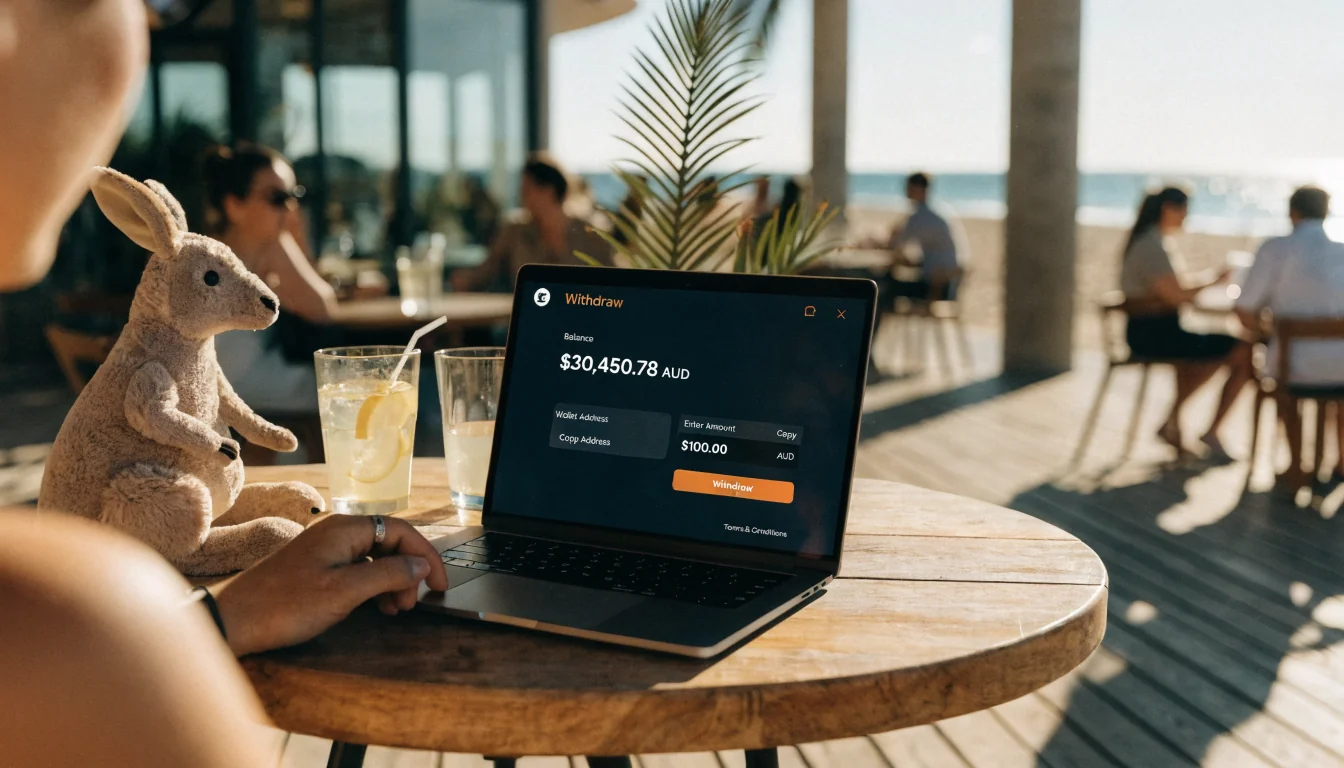
PayID gets mentioned constantly in pokies forums, usually attached to the word "instant" like it’s a fixed feature of the payment rail itself. It isn’t. PayID is just an addressing system — it lets someone send money to a phone number or email instead of a BSB and account number. What happens after that, how fast the funds actually land, what the platform does with them — none of that is guaranteed by PayID. It’s guaranteed, or not, by whoever built the deposit page.
That distinction matters because of where PayID sits legally. It runs through the Australian banking system, which means any site processing it as a real payment rail for casino-style games — slots, roulette, blackjack — is doing something that isn’t available to licensed local operators. There’s no domestic real-money online casino licence to hold in the first place, so a "PayID pokies" site isn’t a licensed Australian brand quietly innovating on banking. It’s almost always an offshore-licensed platform that has plugged into local payment infrastructure to make deposits feel familiar. Worth knowing before assuming PayID equals "regulated."
How PayID works
PayID simply maps a phone number or email to a bank account. It does not guarantee instant settlement; the speed depends on the casino’s internal processing. The method is still routed through Australian banks, so any offshore operator using PayID remains subject to the same regulatory constraints as other payment rails.
What "PayID pokies" actually means in practice
When a search turns up "new PayID pokies Australia," what’s usually being advertised is an offshore casino, licensed somewhere like Curacao or Malta, that accepts PayID as one deposit method alongside cards or crypto. The appeal is obvious — no card details typed into an unfamiliar checkout, no waiting on a wire transfer, just a phone number and a bank app. I’ve used it on a couple of platforms and the deposit side genuinely does clear fast when the operator has set it up properly. The catch is always on the withdrawal side, and it has nothing to do with PayID’s speed — it’s about how quickly the operator releases the funds after identity checks.
That identity check step isn’t optional and isn’t a formality to skip. Withdrawals require completed verification — government-issued ID — before money moves, regardless of how the deposit was made. A site promising instant withdrawals with no ID step is describing something that shouldn’t exist, not a convenience feature.
No‑deposit bonuses: what they are and what they cost later
No-deposit bonuses show up in a lot of "new pokies" marketing because they’re the easiest hook — sign up, verify an account, get credited without depositing anything. The offer itself isn’t complicated. What’s complicated, and what gets buried, is the wagering condition attached to it. Any bonus offered has to come with its wagering requirement shown clearly before it’s accepted, not surfaced after a player has already started spinning. If a no-deposit offer doesn’t show its terms upfront, that’s the whole review right there — walk away, not because the bonus is fake, but because the site is hiding the part that matters.
The industry has moved toward talking about "no-wagering bonuses" as a separate, cleaner category — money or spins with nothing attached beyond basic use. That phrase gets used loosely, though, and marketing pages will happily borrow it for offers that still have conditions somewhere in the fine print. Read the actual terms page, not the banner.
The regulatory backdrop nobody in the marketing copy mentions
Here’s the part that PayID pokies pages tend to skip entirely: the payment landscape for Australian-facing gambling sites has been narrowing, not opening up. According to one industry review of the 2023 amendments to the Interactive Gambling Act, the intent was to stop operators from accepting digital currency payments from Australian users. Then, per the same kind of trade coverage, a further amendment in June 2024 extended that restriction to prohibit both cryptocurrencies and credit cards on Australian-licensed gambling sites. I’m citing this as reported by industry sources rather than as settled law, because the amendments themselves are still being interpreted differently across the sector — and because none of this changes the underlying fact that there’s no domestic online casino licence for pokies to begin with. These restrictions apply to operators and licensed betting products, not to the basic reality that offshore casino platforms sit outside that licensing system altogether.
Offshore licensing limits
Offshore licences (e.g., Curacao, Malta) provide a dispute pathway but do not extend Australian consumer protections; players have limited recourse if the operator fails to honour withdrawals.
What this means for someone comparing PayID deposit options: the payment method itself isn’t the legal question. PayID, cards, e-wallets — all of these move through operators that are, almost without exception, licensed offshore rather than locally. The 2001 Interactive Gambling Act’s ban on online casino games applies to what operators can offer under Australian licence, not to whether an individual can use a bank-linked payment method on an offshore site. It’s the operator’s licensing status and payment handling that carries the legal weight, not the deposit rail’s name.
A practical checklist before trusting a "new PayID pokies" listing
- Confirm the licence is displayed, and note where it’s issued — offshore licensing is the norm here, not a red flag by itself.
- Check whether wagering terms for any bonus, deposit or no-deposit, are visible before you accept the offer.
- Assume ID verification will be required before any withdrawal, PayID or otherwise — a platform skipping that step is skipping a legal requirement, not saving you time.
- Look for the responsible-gambling messaging and complaint/dispute contact details. Their absence says more about the operator than the presence of PayID ever could.
None of this makes PayID pokies "safe" or "risky" as a category — it’s a payment method, not a verdict. The verdict comes from the operator sitting behind it.
Real‑Money Pokies Options for New Zealand Players in 2026
New Zealand players end up in the same structural position as their Australian neighbours, just reached by a different road. There’s no domestic licence covering real-money online pokies here either — nobody issues one, so there’s nothing to check a site against and no local operator to point to as "the legal option." That absence is the whole starting point, not a footnote to it.
What fills the gap is offshore licensing, same as across the Tasman. Many of the crypto casinos active in this space are licensed out of Curacao or Malta, not New Zealand, and not Australia. Worth being precise about what that licence actually does: it lets the operator run a business in its home jurisdiction, it doesn’t extend consumer protections into New Zealand law, and it doesn’t create a body here that will hear a complaint if things go wrong. People read "licensed" and relax. The word is doing less work than it looks like.


On e-wallet logins specifically — the appeal is obvious, one more layer between a player’s bank details and an offshore site. But an e-wallet doesn’t change the underlying legal picture. It’s a payment rail sitting on top of the same offshore setup, not a substitute for regulation that isn’t there.
None of this makes the games unavailable. It changes what "available" means. A New Zealand player can reach these platforms the same way an Australian one does — through an offshore-licensed site rather than a locally regulated one, because the locally regulated version doesn’t exist for pokies.
"Real money" gets used in marketing like it’s the point being sold. It isn’t. The point is which jurisdiction’s rules actually apply once the deposit clears, and that’s decided long before the reels start spinning.
Are there no deposit bonuses at crypto casinos?
Yes, some crypto casinos offer no deposit bonuses, but you shouldn’t assume crypto removes identity checks — verification is still commonly required before withdrawals.
What is a crypto casino?
It’s an online casino that accepts cryptocurrency for deposits and withdrawals instead of, or alongside, traditional card payments. A few newer platforms even run on decentralised protocols where no single company controls funds or outcomes.
What cryptocurrencies do casinos accept?
Bitcoin is the most widely accepted, and most reputable crypto casinos also support Ethereum, Litecoin, USDT, Dogecoin, Solana, Ripple and other altcoins. A platform that accepts only Bitcoin is usually running older infrastructure.
Are my personal and financial details safe?
Crypto payments reduce your exposure to card details, but safety still depends on the operator. Look for a valid licence (e.g., Curacao or Malta) and provably fair systems with published seed data you can actually verify — not just a badge in the footer.