Live Blackjack Online Casinos for Australian Players
 Available in AU
Table of Contents
- Online Blackjack Casinos Available to Australian Players
- Live Dealer Blackjack: What Australian Players Need to Know
- Live Blackjack in Australia – 2026 Market Landscape
- How to Play Live Blackjack at an Online Casino
- Cryptocurrency and Bitcoin Blackjack: What’s Allowed in Australia
- Fundamental Blackjack Strategy for Australian Players
- Selecting a Trustworthy Live Blackjack Platform
- Winning Tips and When to Switch Bets in Live Blackjack
- Live Blackjack Game Variants Explained
- Core Rules of Blackjack You Must Follow
Online Blackjack Casinos Available to Australian Players
Ask around a casino floor long enough and you’ll hear the same question phrased a dozen ways: where can Australians actually play blackjack online. The honest answer starts with what the law says, not with what a website’s homepage claims.
The relevant statute is federal, not state-based, and its exact citation depends on which reference you check. Some sources point to the Interactive Gambling Act 1997, others to the Interactive Gambling Act 2001 — the naming differs between materials, and I won’t pretend one version is correct just to make this tidier. What both versions agree on is the substance: providing online casino games to people living in Australia is prohibited. That prohibition explicitly covers slots, poker, roulette, and blackjack. Not a grey area, not a loophole waiting to be found. Written into the framework itself.
Here’s the part that trips people up. The law targets the operator, not the player. Offering an online casino to Australian residents is illegal. Sitting at home and playing at one isn’t a criminal act for the individual. That distinction explains a lot about how this market actually looks from the inside — a huge supply of offshore platforms willing to take Australian traffic, and zero domestic licensing pathway that would let a local company compete with them legally.
Before you sit down at a live blackjack table, it’s worth knowing which platforms back up the games with solid licensing, fair bonus terms and reliable payouts. Here’s a quick rundown to help you weigh your options.
License: Curacao · Bonus: up to A$2,000 Licensed in Curacao, this casino offers a welcome bonus of up to A$2,000 for new players looking to get started.
Bonus: 100% up to A$750 + 200 free spins, 35x wagering · Payout speed: crypto 30-120 minutes, fiat 24-72 hours · Min. deposit: A$30 Offers a 100% match bonus up to A$750 plus 200 free spins with 35x wagering, and stands out for fast crypto payouts of 30-120 minutes alongside fiat processing within 24-72 hours, with a low A$30 minimum deposit.
License: Curacao eGaming (Roby Games Ltd) · Bonus: 100% up to A$750 + 200 free spins Operating under a Curacao eGaming license via Roby Games Ltd, it provides a 100% bonus up to A$750 along with 200 free spins.
License: Curacao Gaming Control Board · Bonus: up to A$5,000 + 400 free spins Licensed by the Curacao Gaming Control Board, this casino draws attention with a substantial welcome package of up to A$5,000 plus 400 free spins.
License: Curacao Gaming Authority (Jumpman Gaming Ltd) · Bonus: up to A$6,600 + up to 250 free spins across 4 deposits Backed by a Curacao Gaming Authority license through Jumpman Gaming Ltd, it spreads a generous bonus of up to A$6,600 and up to 250 free spins across four deposits.
License: Curacao eGaming OGL/2023/174/0082 (Dama N.V.) · Bonus: up to A$10,000 + 500 free spins across 4 deposits · Min. deposit: A$15 Holding a specific Curacao eGaming license under Dama N.V., it offers a large bonus of up to A$10,000 with 500 free spins spread over four deposits, and a low A$15 minimum deposit makes it accessible.
License: Curacao, operated by Dama N.V. · Bonus: 325% up to 5.25 BTC + 250 free spins across 4 deposits Operated by Dama N.V. under a Curacao license, it caters to crypto players with a 325% bonus up to 5.25 BTC plus 250 free spins across four deposits.
License: Curacao Gaming Control Board OGL/2023/176/0095 (Hollycorn N.V.) · Bonus: up to A$11,000 + 300 free spins (code NEO100) Licensed by the Curacao Gaming Control Board under Hollycorn N.V., it offers a sizeable bonus of up to A$11,000 plus 300 free spins available via a bonus code.
License: Curacao Gaming Control Board OGL/2023/176/0095 (Hollycorn N.V.) · Bonus: up to A$5,000 + 300 free spins across 4 deposits Also licensed by the Curacao Gaming Control Board through Hollycorn N.V., it provides a bonus of up to A$5,000 with 300 free spins distributed across four deposits.
License: Curacao (operating since 2017) · Bonus: 250% up to A$2,000 + 50 free spins on the first of six deposits · Min. deposit: A$20 Active since 2017 under a Curacao license, it offers a 250% bonus up to A$2,000 plus 50 free spins on the first of six deposits, with a A$20 minimum deposit.
No Local Licence, No Local Table
This is the detail that separates Australia from markets where "check the licence" is genuinely useful advice. There is no such thing as a domestically licensed real-money online casino operator here. None. Not one company has gone through an Australian regulator and come out the other side authorised to run blackjack tables for Australian residents online. It’s not a matter of the process being slow or expensive — it’s not possible to obtain that licence at all, because the law that would need to permit it does the opposite.
So when a site markets itself as a "casino for Australians," the licence it’s operating under — if it discloses one — belongs to somewhere else entirely. Malta. Curaçao. The UK, in some cases. That’s not automatically a red flag; plenty of legitimate offshore operators serve Australian players under foreign licences, because that’s the only licence structure available to them for this purpose. But it does mean the protective apparatus a reader might assume exists — a local body they can complain to, a public register to check a name against — simply isn’t there for this category of gambling.
What This Looks Like in Practice
Operators taking Australian blackjack players — names like Casino Mate, Fair Go, HellSpin, Joe Fortune, King Johnnie, Neo Spin Casino, and PlayAmo show up repeatedly in this space — run on offshore licences and market to Australians despite the federal restriction on offering these games domestically. None of them can claim an Australian gambling licence, because that document doesn’t exist for online casino products. Any site that implies otherwise is either confused about its own compliance or hoping the reader won’t check.
I’ve seen operators lean on the "player-side legality" fact as if it were a green light for the business itself. It isn’t. The law not targeting the player is a statement about enforcement priorities, not a certificate of approval for the platform. Both things are true at once: an Australian can legally sit down at an offshore blackjack table, and the entity running that table is doing something the law was written to stop happening on Australian soil. Worth sitting with that contradiction rather than smoothing it over.
Illegal Offering
Playing on a site that offers live blackjack to Australian residents is illegal for the operator and can be shut down without notice.
Table Games Under the Same Umbrella
Blackjack doesn’t get carved out for special treatment here. It sits under the same prohibition as pokies, roulette, and online poker — grouped together as "online casino style games" in the legislation. There’s no separate, softer category for card games versus random number games, no argument that skill-adjacent games like blackjack sit outside the restriction. The Act doesn’t distinguish. A blackjack table streamed to an Australian living room is treated the same as a slot machine reel under this framework.
That matters because some marketing implies blackjack occupies a different legal footing than "casino" games generally — often by association with sports betting, which is genuinely licensed at state and territory level. It doesn’t. Online sports betting and online blackjack are governed by completely different rules, and conflating them is either sloppy or deliberate.
What Actually Determines Access
For an Australian reader, the practical map looks like this:
- No local licensing route exists for online blackjack — so “Australian-licensed casino” is not a claim any legitimate site can make.
- Access happens through offshore-licensed platforms, operating outside the reach of Australian regulators.
- Playing itself isn’t illegal for the individual — the exposure sits with the operator, not the person placing bets.
None of that changes because the calendar flips to 2026, and none of it is likely to change without new federal legislation. The market Australians actually interact with is built entirely offshore. Worth knowing before comparing tables, betting limits, or croupier quality — because the legal ground under all of it is the same regardless of which offshore brand is on the homepage.
Live Dealer Blackjack: What Australian Players Need to Know
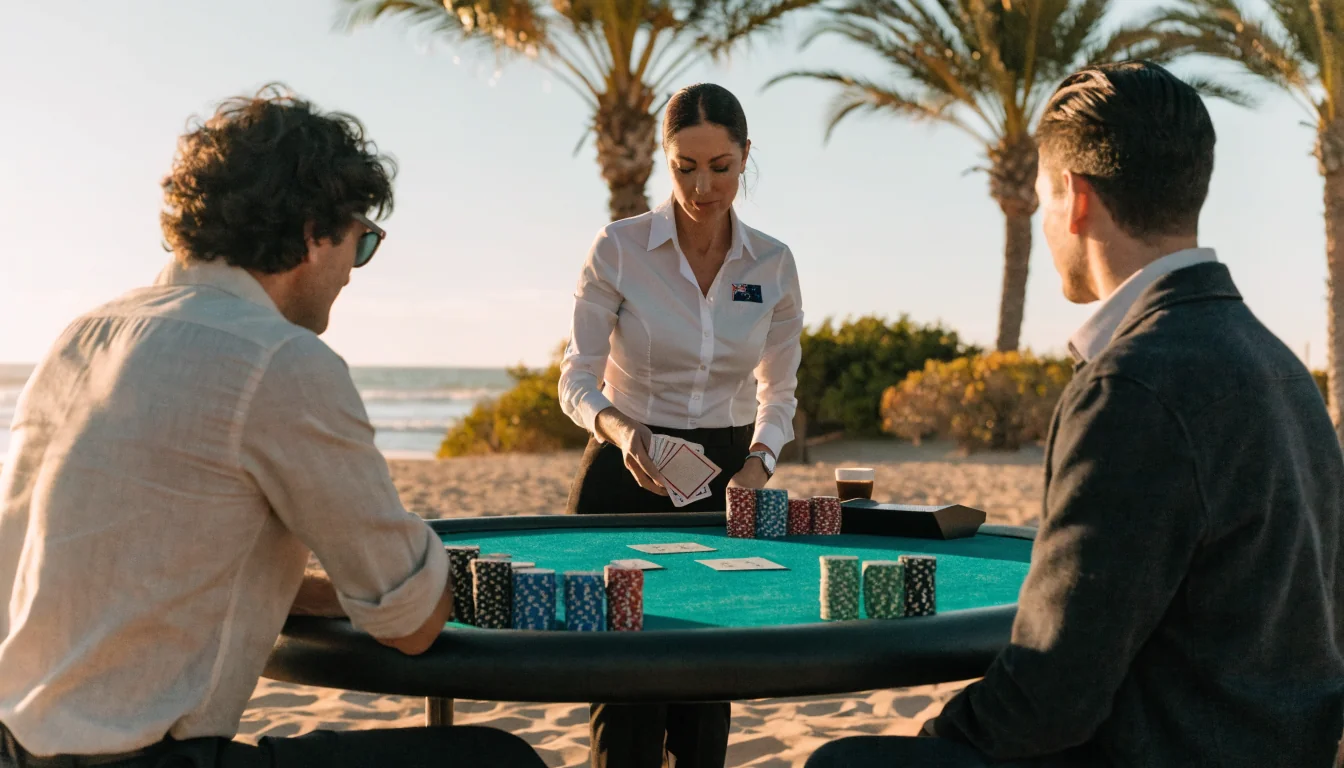
A live dealer table is a streamed version of the game — a real croupier, a physical shoe, a camera feed running to whatever device the player is holding. No random number generator decides the outcome; the cards are dealt by a person in a studio, usually somewhere offshore, and the video runs continuously so players can watch the shuffle and the deal happen in real time. That’s the whole appeal over random number games: you’re watching the thing happen rather than trusting a piece of software to tell you it happened fairly.
What the format doesn’t come with, in Australia, is a local regulator standing behind it. I spent enough time around licensing paperwork to know how much weight that word "regulator" is expected to carry, and here it carries less than people assume.
Who actually oversees this
There’s no single body that governs gambling in this country. That surprises people who expect one federal watchdog and one rulebook. Instead, oversight is split between the Commonwealth and the states and territories, and each layer does a different job.
At the federal level, the Australian Communications and Media Authority enforces the Interactive Gambling Act 2001. ACMA’s job is essentially border control for gambling content — it doesn’t license casino products, it polices what shouldn’t be reaching Australian screens in the first place.
Below that, every state and territory runs its own gambling regulator, with its own scope and its own enforcement priorities. There’s no shared register between them, no single office you’d call to check a licence status that covers the whole country.
One of those territorial bodies does most of the heavy lifting for online wagering: the Northern Territory Racing Commission. It’s become the de-facto authority for online gambling in Australia, not because the law designates it that way, but because it licenses most of the national online bookmakers, who set up there for the lower tax rate. That’s a commercial reason, not a regulatory mandate — worth remembering before assuming the NTRC’s reach extends to everything happening on a screen.
The federal Interactive Gambling Act blocks online casino games, while state bodies only regulate land‑based venues and sports betting, leaving live dealer blackjack in a regulatory gap.
Where live dealer blackjack sits in that structure
Here’s the gap. The NTRC’s licensing role covers online bookmakers — sports and racing wagering, broadly. It doesn’t extend to online casino products. Live dealer blackjack, roulette, baccarat — none of it falls under a domestic licence, NTRC or otherwise, because no Australian authority issues one. State regulators oversee the pokies floors and the tables at physical casinos in their own jurisdictions. ACMA can act against an operator or ask providers to block a site. Nobody in this structure is approving a live blackjack stream and putting a local seal on it.
That’s the piece that doesn’t come across in glossy casino copy talking about "licensed and regulated" live tables. Regulated by whom, for what, is the question worth asking before it’s answered for you.
What this means practically
A few things follow directly from that structure:
- The croupier on your screen is working under a licence issued somewhere else entirely — Malta, the UK, or another jurisdiction with its own online casino framework, none of which extends its protections to Australian residents specifically.
- There’s no Australian complaints authority for a dispute over a live blackjack hand, because there’s no Australian licence covering the game in the first place.
- Federal and state regulators each have a lane, and live dealer casino products sit in the space between those lanes rather than inside either.
I’ve seen operators lean on this fragmented structure deliberately — pointing to an overseas licence as though it answers a question about Australian oversight, when the two things aren’t related. It’s a rhetorical trick more than a legal one, and it works because most players don’t know the NTRC handles bookmakers, not blackjack.
None of this makes the mechanics of the game itself any different. The shoe still runs the same way, the croupier still calls the same actions, the house edge on the felt doesn’t change because of which regulator does or doesn’t have jurisdiction. What changes is who you can appeal to if something goes wrong — and in Australia, for a live blackjack table specifically, the honest answer is nobody local.
Worth sitting with, before the next section gets into what that means for the market shape in 2026.
Live Blackjack in Australia – 2026 Market Landscape
Nothing structural changes in 2026. That’s the part nobody selling a "new" casino wants said out loud. The Interactive Gambling Act 2001 still makes it illegal to offer online casino gambling to Australians, and there’s still no path to a domestic licence for it. Not a slow one, not an expensive one — none. I’ve watched operators ask their lawyers this question and get the same answer every time: you can’t build a compliant local live blackjack table, because the category doesn’t legally exist here. Sports betting has a licensing lane. Racing has one. Live dealer blackjack does not, and 2026 doesn’t add one.
What’s worth understanding is why the landscape still feels confusing despite that clarity, and it comes down to a split that most players never think about until they hit it.
Two regulatory worlds that don’t talk to each other
Land-based casinos — the ones with a physical blackjack pit and a state-issued licence — answer to state government regulators and law enforcement. That’s a completely separate system from the one governing anything online. A casino floor in Melbourne or the Gold Coast operates under rules that have nothing to do with what happens on a laptop.
Enforces the Interactive Gambling Act at the federal level, restricting online casino content from reaching Australian screens.
Licences most offshore bookmakers for sports and racing betting, but does not cover online casino games.
Oversee land‑based casinos and local gambling venues; they have no jurisdiction over offshore live dealer blackjack.
Online gambling, by contrast, sits with the federal Interactive Gambling Act 2001, and the prohibition it sets out covers online casino games, poker, and in-play betting nationally. Live blackjack streamed to a phone falls squarely into that prohibited bucket — it’s an online casino game, full stop, regardless of a croupier dealing real cards on camera.
State bodies still have a role, just not the one people assume. The Victorian Gambling and Casino Control Commission monitors wagering providers for compliance with the National Consumer Protection Framework, and it does this even for providers based in other states. But this oversight is built for the licensed wagering sector — sports and racing operators sitting inside the legal perimeter. When it comes to offshore live blackjack sites, the VGCCC and equivalents like Liquor & Gaming NSW have limited reach. They can flag a problem. They generally can’t touch the operator.
That gap is the market. It’s not a loophole exploited cleverly by anyone — it’s just the shape of a law written to prohibit supply while having almost no lever over suppliers sitting outside the country.
What enforcement can and can’t do
Federal enforcement targets the operator, not the player, and this has been true since the Act was written. Individuals accessing offshore live blackjack aren’t breaking the law by playing. That’s not an oversight; it’s the design. Going after millions of individual accounts was never going to be workable, so the Act aims at the businesses instead — with mixed results, since most of those businesses sit in jurisdictions the Act has no jurisdiction over.
I’d flag one thing here rather than gloss over it: how much this enforcement has actually shifted the market is contested even among people who track it closely, and the sourced figures on site exits and blockings vary depending on who’s counting and when. I won’t pretend there’s a single tidy number for 2026 — there isn’t one that holds still long enough to print.
Land-based tables aren’t the same product
For anyone assuming the state-licensed casino floor is just the "legal version" of the same live blackjack experience — it isn’t, not in a regulatory sense. A dealer at a physical table in a state-licensed venue operates under a completely different rulebook than a stream from a studio overseas. The two don’t merge, they don’t cross-license, and nothing in the 2026 landscape points toward them being unified. If anything, the split is more entrenched than ever, because each side has built its enforcement and compliance machinery around the assumption that the other exists separately.
So the honest description of "the market" in 2026 is this: a legal, state-regulated land-based product that has nothing to do with online blackjack, and a prohibited online category that operates from outside Australian jurisdiction, watched but not controlled by the same bodies that oversee licensed wagering. No licence bridges them. No announced reform closes the gap. That’s not a gloomy prediction — it’s just where the lines currently sit, and where they’ve sat for a while now.
How to Play Live Blackjack at an Online Casino
The mechanics don’t change much between a physical pit and a streamed table, but the sequence of clicks does. Knowing what happens on screen before you sit down saves you from fumbling through a live session with real money already on the table.
Getting to a Live Table
Select a live blackjack table from the lobby, sorted by stake limits and available seats.
Within the betting timer, drag or tap chips into the betting circle before the countdown ends.
Watch the dealer deal cards, use the on‑screen buttons for Hit, Stand, Double, Split or Surrender, and wait for the dealer’s final hand to see the result.
Getting to the table
You pick a table from a lobby, usually sorted by stake limits and how many seats are open. Live blackjack tables run on a schedule dictated by the croupier, not by you, so there’s a waiting window between hands rather than an instant deal. Once a seat opens, the video feed locks onto your table and the betting circle appears on your screen, overlaid on the live stream.
Placing the bet
Betting happens on a timer. A countdown appears, chips of different denominations sit along the bottom of the screen, and you tap to stack your wager into the circle before the clock runs out. Miss the window and you’re sat out for that hand, watching until the next round opens. Some tables let you rebet the previous amount with one tap, which matters when the betting window is short and you don’t want to rebuild a stack chip by chip.
The deal and your options
Once betting closes, the croupier deals from a physical shoe, and optical character recognition software reads the cards in real time to display values on your screen. You’ll see two cards for yourself and one exposed card for the dealer, same as at a physical table. From there the options are the standard set:
- Hit — take another card
- Stand — keep your current total
- Double down — double the bet, take exactly one more card
- Split — separate a pair into two hands, each played independently
- Surrender — where offered, forfeit half the bet and end the hand early
Buttons for whichever options apply light up based on your hand; if a move isn’t legal — doubling after you’ve already hit, say — the button simply won’t appear. You confirm each decision by tapping, and the croupier acts on it after a short delay while the system relays your input.
Dealer’s turn and settlement
The dealer plays last, following a fixed rule for hitting or standing that’s set before the game starts and doesn’t change hand to hand. Once the dealer’s hand is resolved, payouts are calculated automatically and credited to your balance — a standard win pays even money, and a natural blackjack pays at the enhanced ratio shown on the table’s rules screen before you sat down. There’s no chip-counting by hand, no waiting on a dealer to make change; the software settles the moment the last card is revealed.
Payment side of the session
Deposits and withdrawals run through whatever methods the operator lists, separate from the game itself — PayID, bank transfer, or e-wallets are the common rails offshore operators use for Australian players, though none of them accept credit cards or digital currencies for funding play. Withdrawals require identity verification first. That step exists regardless of which table you played or how much you won, and it’s worth doing early rather than after you’ve built a balance you want out.
Cryptocurrency and Bitcoin Blackjack: What’s Allowed in Australia
Every so often I get asked whether paying in Bitcoin makes blackjack somehow "cleaner" — outside the reach of Australian law because the money never touches a bank. It doesn’t work that way, and worth saying plainly: the Interactive Gambling Act 2001 prohibits offering online casino games, including blackjack, to Australian residents regardless of what currency changes hands. The law targets the operator, not the payment rail. Bitcoin doesn’t change who’s breaking it.
Crypto Risk
Using Bitcoin to fund live blackjack does not evade Australian gambling laws and may expose you to unverified operators.
What the Act does not do is criminalise the individual player. An Australian sitting down at an offshore-licensed table, funding it with Ethereum, isn’t committing an offence themselves — the restriction sits with whoever is offering the service into Australia. That distinction matters here because it explains why crypto payment options exist on some offshore sites at all: the operators taking the legal risk are outside the jurisdiction, and the player isn’t the one exposed.
Why most offshore operators steer clear of it anyway
This is the part rarely spelled out. Under the restrictions that govern how gambling can lawfully be offered, operators are not meant to accept digital currencies for deposits or betting. A licensed operator advertising Bitcoin blackjack alongside "responsible gambling" messaging is holding two contradictory positions at once — one signals compliance, the other undermines it. I’ve seen sites quietly drop crypto rails after a licensing review, with no announcement, just a payments page that looks different than it did a few months earlier.
The reason isn’t philosophical. Crypto complicates the identity checks operators are required to run before releasing any withdrawal. A bank transfer or card payment ties a name to a government-issued ID with minimal friction. A wallet address doesn’t, by itself, tell anyone who’s behind it — which is exactly the traceability problem anti-money-laundering rules are built to close. An operator that wants withdrawals verified against real identities has little reason to build a second, murkier front door.
What this means at the table
If a site does list Bitcoin or Litecoin as a payment method, that alone tells you something about how it’s run — not necessarily that it’s dishonest, but that it’s operating with less regard for the verification standards that better-run offshore books apply to every other payment method. "Instant, anonymous, no questions asked" is the pitch. What’s left unsaid is that anonymity cuts both ways: dispute resolution gets harder, and there’s no card issuer or bank to chase if a withdrawal simply doesn’t arrive.
No registry exists here to check an operator’s standing before depositing, in any currency. That’s not a gap specific to crypto — it applies across the board — but it’s worth remembering before treating a crypto-friendly badge as a mark of modernity rather than a shortcut around identity checks.
Fast.
Also unaccountable, if it goes wrong.
Anyone gambling should be 18 or over, and support is available through Gambling Help Online or BetStop for anyone whose play has stopped feeling like entertainment.
Fundamental Blackjack Strategy for Australian Players
Basic strategy is the one part of blackjack that has nothing to do with luck or licensing. It’s pure math: a set of decisions worked out from millions of simulated hands, telling you the statistically correct move for every hand you’ll ever be dealt against every dealer upcard. Nobody enforces it, nobody sells it — you just learn it or you don’t.
I spent years watching players ignore it entirely. They’d stand on a soft 17 because "it feels safer," or split tens because they’d just won a hand and felt confident. The house edge exists because most players play on instinct. Strategy exists to close that gap.
Basic Strategy
A set of mathematically optimal decisions for every possible hand, based on the player’s total and the dealer’s up‑card.
The logic behind the table
Every basic strategy chart runs on the same three inputs: your hand total, whether it’s soft or hard, and the dealer’s upcard. There’s no guessing involved once you know the pattern.
Hard totals (no ace, or ace counted as 1):
- 8 or less: always hit
- 9: double against dealer 3–6, otherwise hit
- 12–16: stand against dealer 2–6, hit against 7 or higher
- 17 or more: always stand
Soft totals (hand includes an ace counted as 11):
- Soft 13–17: generally hit or double depending on dealer upcard
- Soft 18: stand against dealer 2–8, hit against 9, 10 or ace
- Soft 19 or more: always stand
Pairs:
- Always split aces and eights
- Never split tens or fives
- Split other pairs situationally, based on the dealer’s card
None of this requires tracking anything illegal, counting devices, or software. It’s memorisation, not manipulation. That distinction matters more than people think — a strategy chart reduces the house edge; it doesn’t threaten it the way card counting can, which is a different conversation entirely.
Why the dealer’s card decides everything
The upcard tells you the probability the dealer busts. A 4, 5, or 6 showing means the dealer is more likely to break, so you play conservatively and let them do the work. A 7 through ace showing means the dealer probably has a strong hand, so you take more risks to build yours. Every "always stand" or "always hit" rule on the chart traces back to that single idea.

What strategy doesn’t do
It doesn’t guarantee wins. It doesn’t beat the house edge outright — it just gets you as close to even as the rules allow. Payout ratios, deck count and specific table rules (covered separately) still set the ceiling on what basic strategy can achieve. Anyone promising a "system" that flips the edge in your favour is selling something that doesn’t exist in this game.
Learning the chart before sitting down — virtual or streamed — costs nothing and changes how every session plays out. Print it, keep it open on a second screen, whatever works. There’s no rule against consulting it mid-hand, and the players who do consistently outlast the ones who don’t.
Strategy protects your bankroll. It doesn’t protect you from the game itself.
Selecting a Trustworthy Live Blackjack Platform
There’s no domestic licence to check. That’s the first thing to accept before evaluating any site — no state regulator issues real-money online casino licences here, and there’s no public register listing "approved" offshore operators for Australians. Anyone claiming to be checkable against a local authority is misinforming you, not reassuring you.
What’s left to check is the offshore licence itself and how transparently it’s shown. Operators worth a look — names like Casino Mate, Fair Go, HellSpin, Joe Fortune, King Johnnie, Neo Spin Casino or PlayAmo — hold licences from bodies such as the Malta Gaming Authority or the UK Gambling Commission, not from anything Australian. A licence number in the footer that resolves to a real regulator’s site is a basic filter. Its absence isn’t a technicality.
- Verify the offshore licence on the regulator’s site
- Check age‑verification mechanisms
- Use payment methods with identity checks
- Read bonus terms before claiming
- Assume a local Australian licence exists
- Trust sites that only accept crypto or credit cards
- Ignore missing responsible‑gambling tools
- Overlook the lack of a domestic complaints authority
What to look for beyond the licence
- Age gating that actually works. The site should stop you at the door if you’re under 18, not just ask you to tick a box.
- Bankroll and time-limit tools. Deposit caps, session reminders, self-exclusion — these should be built into the account settings, not buried in a help article.
- Identity checks before withdrawal. A platform that pays out without ever asking for ID isn’t being generous, it’s skipping anti-money-laundering steps it’s supposed to run. That should worry you more than it reassures you.
- No credit card or crypto deposits. Operators serving this market properly don’t accept credit cards or digital currencies like Bitcoin or Ethereum for betting. If a site pushes crypto deposits as a selling point, that’s a sign it isn’t built for local compliance.
- Bonus terms shown before you claim anything. Wagering conditions belong on the page before you click “claim,” not in a support ticket after you’ve tried to cash out.
- A complaints path that goes somewhere. Independent dispute resolution membership, a real contact address, a process — not just a contact form that vanishes into nothing.
The tone test
Read the responsible-gambling page. If a platform treats problem gambling as a punchline or buries the warning in tiny grey text, that’s not a copywriting choice — it’s a preview of how it’ll treat you when something goes wrong. The same goes for advertising: a site that runs promotions across social feeds or targets anyone underage is already operating outside the rules it claims to follow.
None of this guarantees a smooth experience. What it does is separate operators that built compliance into the product from ones that bolted a licence logo onto a page and hoped nobody looked closer. If you can’t find Gambling Help Online or BetStop referenced anywhere on the site, that’s the same signal in different clothing.
Trustworthy, here, doesn’t mean "government-approved." It means the operator behaves like AML and harm-minimisation rules apply to it — because, as far as Australian law is concerned, they do.
Winning Tips and When to Switch Bets in Live Blackjack
Every session I’ve watched — from the other side of the pit and from a laptop screen — falls apart for the same reason. Not bad cards. Bad staking. Someone doubles a losing bet to "get even," runs out of runway, and calls it a bad night. It wasn’t the cards. It was the plan, or the absence of one.
Bankroll management in live blackjack isn’t a formula, because there’s no number I can give you that fits every wallet. What I can say: decide the total you’re willing to lose before the croupier deals a single card, split it into a session amount, and treat that split as a hard wall, not a suggestion. The moment you’re topping up mid-session, you’ve stopped managing a bankroll and started chasing one.
Legal landscape unchanged
Online live blackjack remains prohibited for Australian operators in 2026, so players must rely on offshore providers.
Adjusting bet size without fooling yourself
Bet-size progressions get sold as systems. They’re not. Raising a bet after a loss doesn’t change the house edge on the next hand — the shoe has no memory, and neither does the table. What actually helps is duller than any system: keep bets flat and small enough that a losing streak doesn’t force a decision you’ll regret, and only raise size when the bankroll you set aside has genuinely grown, not because you feel a win is "due."
"Switching" — what it actually means
A lot of searches around blackjack mention "switching," and it’s worth clearing up. In games that offer it, switching lets you swap cards between two hands you’re playing at once — a real rule, tied to specific tables and specific payout adjustments. It is not a betting trick, and it has nothing to do with alternating bet sizes to beat the dealer. If a site or a forum post uses "switch" to mean chasing losses with bigger stakes, that’s marketing language wearing a strategy’s clothes.
A short list of what holds up
- Set a loss limit before sitting down, not during.
- Keep bet size flat; adjust only from confirmed profit.
- Don’t treat streaks — hot or cold — as signals.
- Know the difference between a rule variant and a betting habit.
None of this beats the house edge. It just keeps a bad night from becoming a bad month.
Live Blackjack Game Variants Explained
Not every live blackjack table runs on the same rules, and the differences change how a hand plays out more than most players expect.
The standard format seats one croupier against a full table, with each player getting an individual hand and the usual options: hit, stand, double, split. This is the version most people picture when they think of blackjack, and it’s the closest to what you’d find on a land-based casino floor.
A multiplayer variant strips out the seat limit entirely — instead of seven spots, an unlimited number of people can bet on the same hand against the same dealer. It’s built for busy streams where waiting for a seat would kill the pace. The trade-off is that you’re playing the dealer’s cards as dealt, with no side conversation about strategy at the table.
Then there’s a format where the dealer plays two hands face-up instead of one hidden card. Because the house shows both cards from the start, the rules compensate elsewhere — usually a dealer win on ties, so the house edge doesn’t quietly vanish just because you can see more.
Some tables run side bets layered on top of the main game — perfect pairs, matching suits, that kind of thing. They’re optional, they don’t touch the core hand, and the house edge on them tends to run higher than on the base game itself. Worth knowing before you tap them out of curiosity.
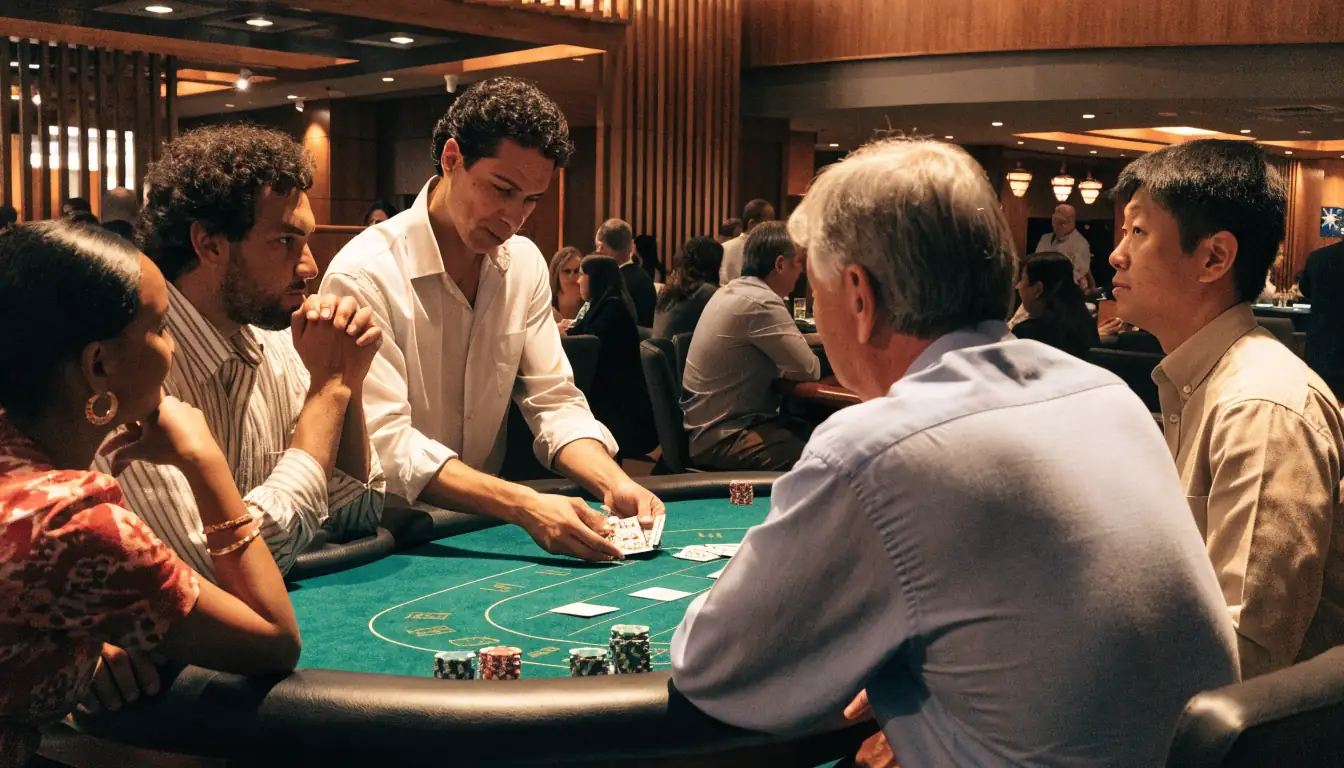
None of these variants change the legal picture. Whatever the format, whatever the table name, it’s still a random number game dressed up with a croupier — and offering it to Australian residents remains outside what the law permits, regardless of which version is on screen.
Core Rules of Blackjack You Must Follow
Strip away the streaming, the chat window, the croupier’s small talk — the game underneath hasn’t changed since it was dealt from a shoe on a felt table. Get the hand to a value higher than the dealer’s without going over 21. That’s the whole contest.
Cards count at face value. Face cards are worth ten. An ace counts as one or eleven, whichever helps the hand more. Two cards making 21 — an ace with a ten-value card — is a natural blackjack, and it beats any other 21 reached across three or more cards.
Dealer rules aren’t up for negotiation, and they shouldn’t be. The dealer hits until reaching seventeen, then stands. No judgment calls, no "feel" — just a fixed rule applied the same way every hand. That fixed behaviour is what makes basic strategy calculable at all.
Payouts follow a standard structure: even money on a straight win, a higher ratio on a natural blackjack. Any table quoting worse than that on blackjack itself is quietly shifting the house edge in its own favour.
Everything else — splitting, doubling, insurance — sits on top of this base. The base doesn’t move.
Are my personal and financial details safe?
No domestic safeguard applies: sites serving Australians run on offshore licences from jurisdictions like Malta or Curaçao, and Australian regulators have no power over them. ACMA can block illegal sites but cannot recover funds or settle individual disputes, so protection depends entirely on the operator’s own foreign licence.
Can I play on an Australian online casino on mobile?
Yes, offshore-licensed platforms accept Australian players on mobile, and playing yourself is not illegal — the law targets operators, not individuals. There is, however, no domestically licensed online casino at all, so any mobile site you use operates under a foreign licence.
What does the future outlook look like for the Australian online casino market?
Not much will change without new federal legislation: online casino games remain prohibited under the Interactive Gambling Act, and no local licensing route exists. Meanwhile enforcement is tightening — ACMA has blocked over 1,200 illegal gambling sites since 2019 and more than 220 services have exited the Australian market.
How can a player verify that an online casino holds a valid licence in Australia?
You can’t — there is no Australian licence for online casinos and no public register to check, because domestic licensing for real-money online casino products does not exist. Any licence a site displays will be from an offshore regulator such as Malta or Curaçao.
What is the step-by-step complaint process for Australian players?
There is no formal domestic complaint route: ACMA can investigate and block prohibited gambling services, but it cannot recover funds or resolve individual disputes with offshore operators. Your only recourse is the operator’s own foreign licence issuer, which sits entirely outside Australian jurisdiction.
Created by the ”Casino Security Info” editorial team.