Anonymous Crypto Casino Australia: How They Really Work
 Available in AU
How Anonymous Crypto Casinos Operate in Australia
There’s no such thing as a licensed online casino in Australia. Not a small one, not a big one, not one that got lucky with a state regulator. The Interactive Gambling Act 2001 prohibits operators from offering online casino-style games — slots, poker, blackjack, roulette — to anyone living here, full stop. One earlier account of the law puts the prohibition under a 1997 version of the same Act; the naming differs depending on which source you check, but the substance doesn’t: providing these games to Australian residents has been off the table for a long time either way. What the law does not do is criminalise the player. Sitting at home and spinning a reel on an offshore site isn’t illegal for the person doing it — the Act was built to target operators, not the person with the account. That gap between "illegal to offer" and "not illegal to use" is the entire reason anonymous crypto casinos exist as a category worth explaining rather than a curiosity.
If you’re after a crypto-friendly casino in Australia where privacy and quick funding matter, it pays to check licensing, bonus terms, and payout speed before signing up.
License: Curacao · Bonus: up to A$2,000 Curacao-licensed and backed by a welcome bonus worth up to A$2,000, giving new players a decent starting cushion.
Bonus: 100% up to A$750 + 200 free spins, 35x wagering · Payout speed: crypto 30-120 minutes, fiat 24-72 hours · Min. deposit: A$30 Offers a 100% match up to A$750 plus 200 free spins with clearly stated 35x wagering, and notably fast crypto payouts of 30-120 minutes versus 24-72 hours for fiat, with a low A$30 minimum deposit.
License: Curacao eGaming (Roby Games Ltd) · Bonus: 100% up to A$750 + 200 free spins Licensed under Curacao eGaming via Roby Games Ltd, pairing that regulatory backing with a 100% bonus up to A$750 plus 200 free spins.
License: Curacao Gaming Control Board · Bonus: up to A$5,000 + 400 free spins Holds a Curacao Gaming Control Board license and stands out for a generous welcome package of up to A$5,000 plus 400 free spins.
License: Curacao Gaming Authority (Jumpman Gaming Ltd) · Bonus: up to A$6,600 + up to 250 free spins across 4 deposits Licensed by the Curacao Gaming Authority under Jumpman Gaming Ltd, with a substantial multi-deposit bonus reaching up to A$6,600 plus up to 250 free spins spread across four deposits.
License: Curacao eGaming OGL/2023/174/0082 (Dama N.V.) · Bonus: up to A$10,000 + 500 free spins across 4 deposits · Min. deposit: A$15 Operates under a specific Curacao eGaming license (Dama N.V.) and offers one of the larger welcome bonuses on this list, up to A$10,000 plus 500 free spins over four deposits, with an accessible A$15 minimum deposit.
License: Curacao, operated by Dama N.V. · Bonus: 325% up to 5.25 BTC + 250 free spins across 4 deposits Run by Dama N.V. under Curacao licensing, with a crypto-focused bonus structure offering 325% up to 5.25 BTC plus 250 free spins across four deposits.
License: Curacao Gaming Control Board OGL/2023/176/0095 (Hollycorn N.V.) · Bonus: up to A$11,000 + 300 free spins (code NEO100) Licensed by the Curacao Gaming Control Board (Hollycorn N.V.) under a specific OGL registration, with a large bonus of up to A$11,000 plus 300 free spins available via a bonus code.
License: Curacao Gaming Control Board OGL/2023/176/0095 (Hollycorn N.V.) · Bonus: up to A$5,000 + 300 free spins across 4 deposits Also operated by Hollycorn N.V. under the same Curacao Gaming Control Board license type, offering up to A$5,000 plus 300 free spins spread across four deposits.
License: Curacao (operating since 2017) · Bonus: 250% up to A$2,000 + 50 free spins on the first of six deposits · Min. deposit: A$20 A Curacao-licensed casino operating since 2017, offering a 250% bonus up to A$2,000 plus 50 free spins on the first of six deposits, with a A$20 minimum deposit.
So every operator marketed to Australians under a "crypto casino" or "anonymous casino" banner is, by definition, offshore. It holds a licence from somewhere else — Curaçao, one of the Caribbean or Central American jurisdictions, sometimes nothing anyone recognises — and it markets to Australian players anyway, in AUD, with local payment rails bolted on. I’ve sat in on enough operator-side conversations to know this isn’t a grey area anyone is confused about internally. Everyone knows the games aren’t licensed here. The word "anonymous" in the marketing isn’t describing a legal shield. It’s describing a UX decision: less friction at signup, no demand for a driver’s licence scan before you’ve even deposited. That’s a different thing from being outside the law, and conflating the two is where players get hurt.
What "anonymous" actually means in practice
The term gets used loosely enough that it’s worth being precise about what it isn’t. An "anonymous" crypto casino does not mean the operator never learns who you are. KYC checks are mandatory at every Australian-facing online casino, anonymous-branded or not — that requirement doesn’t evaporate because the front end lets you sign up with just an email and a wallet address. What changes is when the check happens, not whether it happens.
In practice, "anonymous" describes the onboarding sequence:
- Sign-up asks for minimal information — email, password, sometimes nothing but a crypto wallet connection.
- You can deposit and start playing before submitting any identity document.
- The identity check gets triggered later, almost always at the point you try to withdraw.
That last point is the one that catches people. The absence of ID at the door reads as freedom. It’s actually a delay of the same requirement to a moment when you have money on the line and less patience for paperwork. I’ve seen this design used well and used cynically — the mechanics look identical from outside either way, and you can’t tell which one you’re dealing with until you try to cash out.
The core payment layer: crypto sits alongside, not instead of, fiat
Cryptocurrency payments are widely accepted across Australian online casinos at this point — this isn’t a niche feature reserved for specialist sites anymore. But "crypto casino" rarely means crypto-only. Most of these operators run a payment stack that includes cards, e-wallets, bank transfers and crypto side by side, and which of those actually appear on your account depends on the operator and, from what I’ve seen, on where you’re connecting from. That’s not a fixed menu — availability shifts operator to operator and even session to session, according to one industry review of the space, and it’s not something you can treat as a fixed market rule.
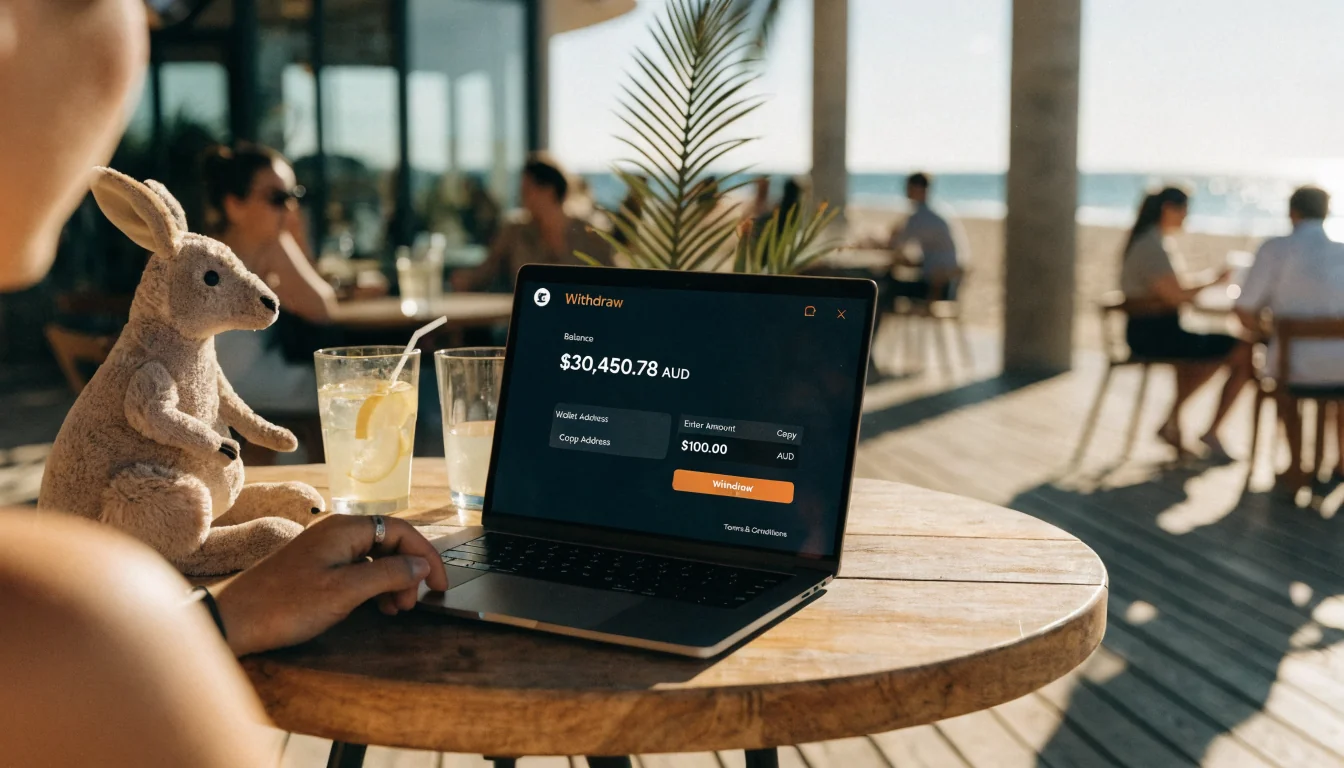
Here’s roughly how the four payment families stack up against each other on the two things that matter — speed and cost — based on how they’re generally described in operator terms and conditions:
| Method | Deposit speed | Withdrawal speed | Typical friction |
|---|---|---|---|
| Cards (Visa, Mastercard) | Instant | 1–5 business days | Mastercard often accepted for deposit but restricted for withdrawal |
| E-wallets (Skrill, MiFinity, Jeton) | Instant | Same-day to 48 hours | Faster than cards but availability varies by operator |
| Bank transfer | Instant to same-day | Up to 7 business days | Slowest of the standard rails |
| Cryptocurrency | Minutes | Typically within 24 hours | Network fees can apply; volatility between deposit and withdrawal |
Visa is close to universally accepted for casino payments in Australia. Mastercard shows up just as often on the deposit side but gets restricted more frequently when it comes to pulling money back out — a limitation that sits with the card networks’ own policies on gambling transactions as much as with any single casino’s choice. None of this is exotic. It’s the same hierarchy you’d see in most online payment ecosystems: cards easy in, harder out; e-wallets faster both ways when the operator supports them properly; bank transfer reliable but slow; crypto quick unless the network itself is congested.
What’s specific to Australia is the prepaid voucher layer sitting underneath all of that. Flexepin, according to that same industry source, is a popular option among local players, and it works on a model that’s genuinely different from cards or e-wallets — you buy a PIN in-store or online, load a fixed amount, and that amount becomes your deposit ceiling. There’s no bank account behind it to trace, no card statement showing "casino" next to a transaction. It’s a closed loop. And it’s deposit-only. Vouchers like Flexepin, CashtoCode and Neosurf can put money in but can’t take money out — withdrawals have to go somewhere else entirely, which is the first place the "anonymous" framing runs into a wall.
The Same Method Rule means you cannot withdraw to a different payment type than you deposited with, so prepaid vouchers force a later switch to a traceable method such as crypto or a bank account.
The Same Method Rule quietly limits how anonymous any of this can be
Australian-facing casinos generally enforce what’s known as the Same Method Rule: money has to leave the way it came in. Deposit by card, withdraw to the same card. Deposit by e-wallet, withdraw to the same e-wallet. This exists as an anti-fraud and anti-money-laundering control, and it’s close to universal across the industry regardless of how an operator brands itself.
For crypto, this creates an obvious asymmetry with the voucher products. A prepaid voucher can’t receive a withdrawal — there’s no account behind it to send funds to — so the same money that went in on a Flexepin PIN has to come out through a different channel entirely: a crypto wallet, an e-wallet, sometimes a bank account. That’s the point at which whatever anonymity existed at signup starts to erode. You can fund an account without disclosing much of anything. You cannot, in practice, get money back out without eventually connecting the account to something that identifies you — a wallet address tied to an exchange that already knows who you are, a bank account, an e-wallet with its own KYC layer sitting behind it.
I don’t say this to knock the model. It’s a sensible control, and it’s one of the few things standing between a casino’s payment system and being a straightforward laundering vector. But it means "anonymous crypto casino" describes the first five minutes of a relationship with an operator, not the whole of it.
Because verification is deferred to the withdrawal stage, the perceived anonymity disappears as soon as you try to cash out.
Where crypto genuinely changes the picture
Crypto’s actual advantage isn’t invisibility. It’s speed and the fact that it sidesteps a card network’s opinion about gambling merchant codes entirely. A crypto deposit typically clears in minutes rather than waiting on a card issuer’s authorisation logic, and a crypto withdrawal, once approved on the casino’s side, tends to move within a day — noticeably faster than the multi-day wait that bank transfers can carry. That gap matters more than the branding does. A player choosing crypto because they want their money moving quickly is making a rational choice grounded in how payment rails actually behave. A player choosing crypto because they think it keeps the casino from ever knowing who they are is working from a premise the KYC requirement is going to contradict the first time they try to cash out anything meaningful.
There’s also a currency layer worth flagging. Most Australian-facing casinos price everything in AUD and let you deposit and withdraw in AUD even when crypto is the payment rail underneath, which avoids the conversion fees that come with running an account in a foreign currency. Crypto deposits sit on top of that as a funding method rather than replacing the AUD accounting entirely — you’re not necessarily gambling "in Bitcoin," you’re often funding an AUD balance with Bitcoin and then playing with AUD-denominated bets. Whether that’s true of any specific operator depends on how that operator has built its back end, and it’s not something advertised prominently, because "AUD balance funded by crypto" is a less exciting pitch than "play anonymously with Bitcoin."
Fees on the crypto side are generally rare as a casino-imposed charge, but network fees are a different animal entirely — they belong to the blockchain, not the operator, and they apply regardless of what the casino’s terms say about its own charges. The same goes for FX conversion where a casino is settling in a currency other than AUD, or e-wallet withdrawal fees layered on top of an already-slower rail. None of this is disclosed with much consistency, and the honest answer is that fee structure is one of the areas where reading the specific operator’s terms matters more than any general rule I could give you here.
Legal Risk
Operating an “anonymous” crypto casino for Australian players breaches the Interactive Gambling Act 2001 and can lead to enforcement action against the operator.
Why withdrawals slow down — and it’s rarely the game
This is worth separating out clearly, because it’s the single most misunderstood part of how these sites work. A slot doesn’t decide how fast your money moves. The payment method does, the verification status of your account does, and the operator’s own processing window does — in that order, roughly. When people say a casino is "holding" their withdrawal, what’s usually happening is one of:
- Verification hasn’t been completed. KYC checks are compulsory everywhere in this market, and if the operator delayed that check to the withdrawal stage — which is exactly what the “anonymous” onboarding model does — the delay you’re experiencing now is the same check you skipped at signup, just moved to a worse moment.
- Wagering conditions attached to a bonus haven’t been cleared. Bonus funds and their conditions lock the underlying balance until the wagering requirement is satisfied, and this applies regardless of whether the deposit that triggered the bonus was made in crypto, card, or anything else.
- The payment method itself has a slow processing window. Bank transfer withdrawals in this market can run up to seven business days according to standard operator terms — that’s simply the rail, not a sign anything’s wrong.
- The operator’s own processing queue. Even a “fast” method sits behind however long the casino’s back office takes to review and release the payment before the network or bank ever sees it.
The most common single reason a withdrawal gets paused, across the market generally, comes down to one of the first two: verification or bonus conditions. Not the crypto network. Not the game. The mechanism that feels the most "instant" — a crypto withdrawal that can process within a day once approved — is exactly as fast as the operator’s review process allows it to be, and no faster. A casino that’s slow to verify accounts will be slow to release crypto withdrawals too. The blockchain isn’t the bottleneck; the compliance desk is.
I’ve watched operators use this to their advantage in a way that’s worth naming plainly. A frictionless, near-anonymous sign-up funnel gets players depositing and playing fast — that’s the entire point of the design, and it works. The verification gate that shows up later, right when someone’s trying to withdraw a win, isn’t hidden exactly. It’s in the terms. But it’s also not the first thing anyone reads, because nobody reads the terms before they deposit A$50 to try a slot. "No verification needed" is a phrase that gets used loosely in marketing copy. What it actually means, almost every time, is "not needed yet."
Fund security sits separately from anonymity
It’s worth keeping two different questions apart, because casino marketing tends to blur them together: is my money safe in transit, and does the casino know who I am. These aren’t the same question and a "yes" to one says nothing about the other. On the security side, payment options used by this class of operator — cards, e-wallets, crypto rails — generally run on SSL/TLS encryption with PCI-DSS compliance for the card-processing side of things. That’s a baseline, not a differentiator; it’s the same standard any competent e-commerce site would carry. It tells you the connection between your browser and the payment processor is encrypted. It tells you nothing about whether the operator holding your balance is solvent, whether it’ll honour a big win, or whether its idea of "verification" is going to move at a pace you find reasonable.
Some payment providers build in their own controls independent of anything the casino does. Revolut, for instance, lets account holders block gambling-category transactions or set spending limits directly on their own card — a control that sits with the payment provider, not the casino, and works whether or not the casino in question ever asks for ID. That’s a meaningfully different kind of protection from encryption in transit: it’s a limit you set on yourself, enforced by an entity that isn’t the one taking your bets.
Location and operator variance is the honest caveat here
I’d be lying if I gave you a single, stable list of "the payment methods available in Australia" as though it were a fixed menu. It isn’t. What one operator offers a player connecting from Sydney can differ from what another offers a player connecting from regional Queensland, and it can differ again from what either offered six months ago — this is a market that reshuffles its payment partnerships regularly, often for reasons that have nothing to do with the player and everything to do with which processor is willing to touch gambling transactions this quarter. One industry review put together a snapshot of card, bank transfer, e-wallet and crypto availability, and it’s a reasonable starting picture — but it’s a snapshot of one moment for one set of operators, not a market-wide constant, and it will be out of date faster than most players expect. Anyone telling you a fixed set of payment methods is guaranteed at "an anonymous crypto casino" as a category is describing an average, not a guarantee.

The realistic mechanics, stripped of the marketing
Put together, here’s what actually happens end to end, without the branding:
- You find an offshore operator marketing to Australian players, licensed somewhere other than Australia because no domestic licence for this exists.
- Sign-up requires minimal information up front — this is the “anonymous” part, and it’s real as far as it goes.
- You deposit via whichever rail the operator supports for your location — card, e-wallet, bank transfer, prepaid voucher, or crypto — each with its own speed and cost profile.
- You play. Any bonus attached to that deposit comes with wagering conditions that lock the funds until met.
- When you try to withdraw, KYC checks activate if they haven’t already — this is not optional and not skippable, regardless of what the sign-up experience implied.
- Withdrawal is routed back through the Same Method Rule wherever the payment type allows it; where it doesn’t (vouchers), it goes out through an alternative channel that will itself require verification.
- Processing time from there depends on the rail — crypto and e-wallets tend to move faster than cards, and bank transfer is reliably the slowest — layered on top of however long the operator’s own review takes.
None of that is secret, exactly. It’s just not the story told at the point of sign-up, where "anonymous" is doing a lot of work to suggest something closer to "untraceable" than the reality supports. The honest version is that anonymity here is front-loaded and temporary — real at the door, gone by the time money needs to leave.
Bitcoin Casino Bonuses and Their Withdrawal Implications
A "no deposit" bonus is the phrase that sells the whole idea of an anonymous crypto casino. Sign up, get credited, play without putting a cent of your own money in. What that phrase doesn’t sell is the part where the bonus decides when — or whether — that money becomes withdrawable.
Wagering requirements are the mechanism. Funds tied to a bonus, whether it landed in the account for signing up or for making a Bitcoin deposit, stay locked until the stated conditions are cleared. That’s true across Australian online casinos generally, not something specific to crypto operators. What crypto operators change is the framing: an anonymous sign-up process makes it easy to believe the account itself is anonymous all the way through, bonus included. It isn’t. The wagering lock sits underneath the account regardless of how little personal data was collected to open it.
Where "anonymous" stops applying
This is the point worth being blunt about. A casino can let a player register with an email and a wallet address, take Bitcoin deposits, and never ask for a name during play. That’s the anonymous part, and it’s real. It ends at the withdrawal request.

KYC checks are mandatory at every Australian online casino, and bonus funds are exactly where that requirement gets enforced hardest. I’ve seen the same pattern repeat: a player claims a bonus, plays it through, hits "withdraw," and only then gets the document request. The verification wasn’t skipped — it was deferred to the moment it actually matters to the operator, which is the moment money is meant to leave rather than come in. Calling that a "no verification" casino is technically half true and practically misleading. No verification to play. Full verification to cash out.
The most common reason a withdrawal gets paused isn’t fraud or a broken system — it’s this. Either the KYC hasn’t been completed, or the bonus conditions haven’t been satisfied, or both at once, because the platform often won’t run the verification check until a withdrawal is actually requested.
How Bitcoin bonuses differ from standard crypto casino terms
A "standard" crypto casino operation — deposit, play, withdraw, no promotional funds involved — moves differently to a bonus-funded one:
| Standard crypto play | Bonus-funded play | |
|---|---|---|
| Funds available to withdraw | Deposit + winnings, generally free to withdraw once KYC clears | Locked until wagering conditions are met |
| Verification timing | Usually triggered at first withdrawal | Same trigger, but often scrutinised more closely given bonus abuse patterns |
| Speed once cleared | Crypto withdrawals are usually processed within a day | Same processing speed applies — the delay is upstream, in clearing the wagering, not in the payment rail itself |
That last row matters because it’s where a lot of confusion sits. Bitcoin itself isn’t slow. Once a withdrawal is actually approved, crypto deposits take minutes and withdrawals typically clear within a day. The bonus doesn’t make the blockchain slower — it delays the point at which the operator agrees the withdrawal can be initiated at all. Compare that to a card-funded account, where deposits post instantly but withdrawals can run to several business days even without a bonus attached; crypto’s speed advantage is real, but it only kicks in after the wagering gate, not before it.
The no-deposit bonus specifically
No-deposit bonuses are the ones I’d read most carefully, precisely because they cost the player nothing upfront and therefore attract the tightest conditions on the back end. An operator handing out free credit has no deposit to recover costs from if the player simply withdraws it — so the wagering requirement, the verification check, and often a cap on how much bonus-derived winnings can actually be cashed out are all doing the work that a deposit would otherwise do. None of that is disclosed as clearly as the headline offer.
"Instant" bonus credit is the other word worth pausing on. The credit itself does land instantly — that part is usually true. What it buys is playtime, not liquidity. Fees are rare across Australian casinos in general, but the bigger cost of a bonus was never a fee — it’s the time and turnover required before the balance is yours to move, and that cost doesn’t show up anywhere in the promotional copy.
None of this makes Bitcoin-based bonuses worse than fiat ones. The wagering mechanic is identical whether the funds arrived by card or by wallet address. What crypto adds is the illusion of a fully anonymous loop — deposit anonymously, play anonymously, cash out anonymously — when in practice only the first two steps hold. The wallet address that received the bonus is not the same as a verified identity, and the casino knows the difference even when the marketing doesn’t say so.
Fastest payouts in this market — sometimes near-instant — belong to accounts that already cleared KYC before the bonus was even claimed. That’s the practical takeaway: verification done early removes the one variable that actually causes delay. Bonus terms aren’t going to explain that. They don’t need to.
Instant Bitcoin Withdrawals: What Works Anonymously
"Instant" gets printed on a lot of banners. What it actually means, once KYC is done and no bonus is locking the balance, is that a crypto withdrawal clears the network in minutes and lands in the wallet without a bank sitting in between.
According to one industry review, crypto withdrawals are typically processed within 24 hours, and the fastest payouts across the Australian market come in under two hours — sometimes close to instant. The difference from fiat isn’t the blockchain being faster than a bank, though it is. It’s that nobody upstream is checking the transfer against a business day.
No settlement window. No bank holiday. No "processing" queue that only moves Monday to Friday.
None of that removes the verification step itself — a casino still confirms who’s withdrawing before it lets Bitcoin out the door. Speed starts only after that box is ticked.
Regulatory Landscape and Performance of Anonymous Casinos in 2024‑2026
Every search for the "best" anonymous crypto casino runs into the same wall: the legal ground under the whole category is contested, and no independent body publishes performance data on operators that fall outside it.

The Interactive Gambling Act 2001 is the Commonwealth law that governs this space. It exists, according to its own stated purpose, to protect the public through harm minimisation — not to license or endorse the products it covers. Under it, online casino-style games — slots, poker, blackjack, roulette — are prohibited. That prohibition sits at the centre of why a "top‑list" of anonymous casinos for 2026 can’t be built honestly. A list implies comparison against some standard: licensing tier, audited payout data, a regulator’s public record. None of that exists for a category the law doesn’t recognise as a licensable product in the first place.
I’ve seen affiliate pages present rankings dressed up as research — star ratings, "verified" badges, editorial scores. None of it traces back to a regulator or an audit anyone can check. It’s marketing wearing the costume of due diligence.
What can be said with any confidence is narrower than a list: the legal framework hasn’t moved between 2024 and 2026, and the products operating in this space haven’t gained any new legitimacy in that window either. No published benchmark tracks how anonymous casinos perform against each other, because performance benchmarking assumes a reporting obligation that doesn’t apply here.
So the honest answer to "which ones are best" isn’t a ranking. It’s an explanation of why the ranking can’t exist yet — and won’t, until there’s a body collecting the numbers a ranking would need.
No standard. No scoreboard.
Are crypto casinos legal in Australia in 2026?
No online casino is legally licensed in Australia — the Interactive Gambling Act 2001 prohibits operators from offering online casino-style games such as slots, poker, blackjack and roulette to Australian residents. However, playing on an offshore site isn’t a crime for the individual player, since the law targets operators rather than users.
What are the typical withdrawal times for crypto casinos?
Cryptocurrency withdrawals are usually processed within 24 hours, after a deposit takes just a few minutes. Most delays come from KYC verification at the point of withdrawal rather than the payment method itself.
Are my personal and financial details safe?
Yes, in terms of the payment layer — the featured payment options use SSL/TLS encryption and are PCI-DSS compliant. But note that even ‘anonymous’ casinos still run mandatory KYC checks, typically triggered when you request a withdrawal, so the operator does eventually learn who you are.
Can I withdraw to any payment method I like?
No — Australian casinos generally require withdrawals to be sent to the same payment method used for deposits. This also means deposit-only vouchers like Flexepin, CashtoCode and Neosurf can’t be used for cashing out, so you’ll need an alternative withdrawal method.
Written by the editors at Casino Security Info.