Aussie Crypto Casino 2026: What Actually Changes
 Available in AU
Table of Contents
- Understanding Crypto Casinos in Australia
- Australian Regulatory Landscape for Crypto Gambling
- How Online Play Impacts Payments and Withdrawals
- What Makes a Crypto Casino ‘Best’ in 2026
- Cryptocurrency Integration in Australian Casinos
- Slot Gaming with Crypto: What Players Need to Know
- Deposit Bonuses and Their Real Value
- KYC Requirements: Mandatory and What They Mean
- Cryptocurrency‑Only Casinos: Pros and Cons
- Free Spins and Review Highlights for Crypto Casinos
Understanding Crypto Casinos in Australia
A crypto casino, in the strict sense, is an offshore online casino that lets players fund an account with cryptocurrency instead of — or alongside — a card or bank transfer. Nothing about the games changes. The slots, the roulette wheel, the live dealer feed are the same product a fiat player sees. What changes is the rail the money travels on. That distinction matters more than most marketing pages let on, because it’s the payment layer, not the licence, that these sites are actually selling.
No operator offering this kind of platform is licensed in Australia, because no such domestic licence exists. Every "crypto casino" an Australian player finds is licensed somewhere else — and that’s a regulatory detail worth sitting with before we get to how the money moves. I’ll come back to it properly in the next section. For now, the point is narrower: this is a description of a payment model, not an endorsement of legality, and the two get blurred constantly in how these products present themselves.
What actually happens when you deposit
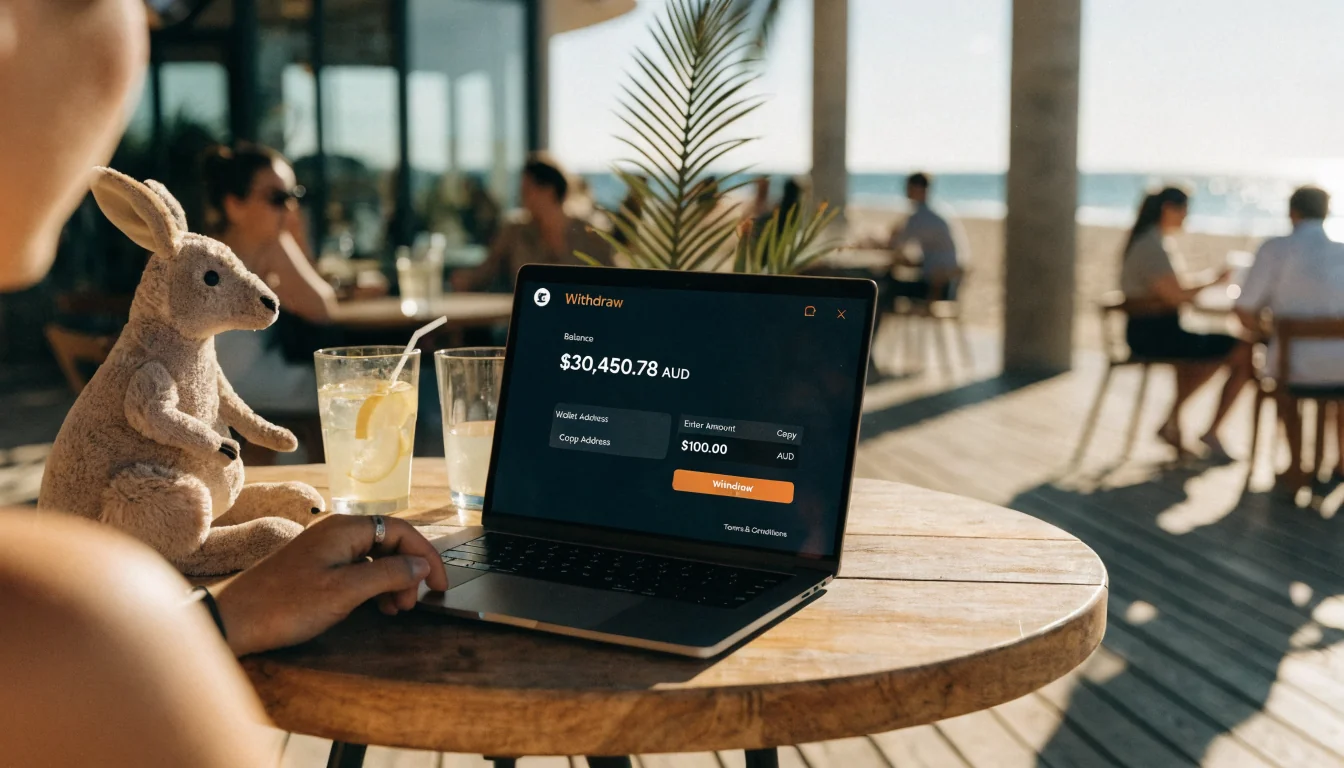
Strip away the branding and a crypto deposit is a straightforward transaction: the player sends coins from a wallet to an address the casino generates, the blockchain confirms it, the balance appears. According to industry reviews of how these deposits behave in practice, the process from wallet to credited balance takes a few minutes — a fraction of the time a bank transfer needs to clear. Withdrawals run the other direction and, per the same kind of review, are usually processed within 24 hours once the operator has cleared its own checks.
That "once cleared" clause is doing a lot of work. Nothing about crypto’s speed exempts a player from the casino’s internal process. KYC checks are mandatory at every Australian-facing online casino regardless of payment method, and a withdrawal request sits in a queue until that verification is done. I’ve seen players assume that because crypto moves fast on-chain, the casino side moves at the same pace. It doesn’t. The blockchain confirms in minutes; the operator’s compliance team works on its own clock.
Why funds get held up
The most common reason a withdrawal gets paused isn’t the payment rail at all — it’s verification or unmet bonus conditions. A player deposits crypto, plays through a welcome offer, and then finds the payout frozen because ID documents haven’t been submitted, or because wagering requirements attached to the bonus haven’t been cleared. Wagering requirements can lock funds until the stated conditions are satisfied, and that lock applies whether the original deposit was crypto, card, or e‑wallet. Crypto doesn’t buy an exemption from any of this. It only changes how fast the money moves once everything else is in order.
This is worth saying plainly because "crypto" is often marketed as synonymous with "instant" and "anonymous." Instant, sometimes, for the transfer itself. Anonymous, no — not once KYC is applied on top.

The payment mix a player actually encounters
Cryptocurrency payments are widely accepted across Australian-facing online casinos, but they rarely sit alone on a cashier page. Most operators run a mixed menu, and crypto is one line among several. A typical cashier screen might include:
- Cryptocurrency — deposits confirm on-chain within minutes; withdrawals depend on the operator’s own review queue on top of that.
- Prepaid vouchers, of which Flexepin is one option that industry coverage flags as popular with Australian players going into 2026 — bought with a PIN, used for deposits, not available for taking money back out.
- Cards and e‑wallets, running alongside crypto rather than being replaced by it — each with its own processing behaviour, covered in the payments section that follows this one.
The mix varies by operator, and no two cashier pages look identical. What’s consistent is that crypto sits inside a broader menu rather than replacing it outright — most self-described "crypto casinos" still take a card or an e‑wallet if crypto isn’t the player’s thing.
Why crypto appeals to this market specifically
Australian players have fewer domestic banking options for gambling than players in markets with a regulated local casino industry, because — again — there isn’t one. Cards and bank transfers routed toward offshore gambling sites get flagged or blocked with some regularity, which pushes both operators and players toward payment rails that don’t run through the same choke points. Crypto is one of those rails. It’s not the only one — prepaid vouchers exist for exactly the same reason, letting a player fund an account without a bank ever seeing the destination — but crypto is the one that also settles fast and crosses borders without a correspondent bank in the middle.
Crypto deposits are processed within minutes, but withdrawals may still be held up by KYC checks and the operator’s internal review queue, meaning the overall speed is not guaranteed.
None of that makes the underlying activity domestically licensed. It makes the payment mechanics more convenient for players operating in a market where the conventional rails are unreliable. Those are two separate facts, and conflating them is exactly how a payment-speed advantage gets misrepresented as a legal green light.
What "crypto casino" doesn’t mean
A short list of things the term doesn’t imply, because I’ve seen all three assumed by first-time players:
- It doesn’t mean unregulated in the sense of “no rules at all.” The casino still runs KYC, still applies wagering terms, still has an internal review process for payouts.
- It doesn’t mean anonymous. The wallet address isn’t tied to a name, but the account behind it goes through identity verification like any other.
- It doesn’t mean Australian-licensed. No such licence exists for this kind of platform, and a crypto payment option changes nothing about that fact.
"Fast, borderless, and simple" is the pitch on most of these sites. What it actually means, once you take a withdrawal through the process, is: fast on the blockchain side, and exactly as slow as the operator’s compliance queue on the other. Worth knowing before the deposit, not after the first cash-out request sits pending.
The next section works through the legal framework that sits underneath all of this — what’s actually permitted, what isn’t, and where an Australian player’s own exposure begins and ends.
Australian Regulatory Landscape for Crypto Gambling
The law that matters here is the Interactive Gambling Act 2001, the Commonwealth statute that governs online gambling in Australia. It was written with harm minimisation as its stated purpose, not consumer choice. Worth saying plainly, because it changes how everything else in this section should be read: this is not a licensing regime you can slot a crypto casino into. It’s a prohibition.
Online casino-style games — slots, poker, blackjack, roulette, whatever wheel or reel format you name — cannot legally be offered to people in Australia. Not "offered without a licence." Not "offered pending approval." There is no domestic licence for this. None exists to apply for, none exists to display, none exists to check. Sports betting and racing are a different story — those are licensed at state and territory level, and lotteries too. Casino games sit outside that entirely.
Legal Risk
Running an offshore crypto casino that offers Australian‑facing slots is illegal for the operator under the Interactive Gambling Act 2001.
So where does that leave a page like this one, and where does it leave a player? The Act targets operators, not individuals. Running an unlicensed online casino for Australian residents is the offence; sitting down and playing at one isn’t. That asymmetry is the whole shape of this market — it’s why offshore platforms serve Australian players openly while no Australian company can legally do the same from home soil. I’ve seen operators lean on that gap in their marketing copy, phrasing it like a loophole they discovered. It isn’t a loophole. It’s just how the statute was drafted, and everyone in the industry knows it.
What "licensed" actually means here
You’ll see review sites tell readers to "check the licence" or "only play at regulated casinos." On most markets that’s sound advice. Here it’s close to meaningless, because there’s no public register to check against and no domestic body issuing the licence in question. A crypto casino serving Australian players is, by definition, operating under a licence from somewhere else — Curaçao, Malta, elsewhere — and that licence says nothing about compliance with Australian law, because Australian law doesn’t offer one to comply with. "Fully licensed" in an operator’s footer is true and irrelevant at the same time. Worth remembering before it does any reassuring work in your head.
Payments sit inside this same gap
Crypto casinos operating this way still need a way to move Australian dollars in and out, and that’s where the picture gets more mixed than the headline law suggests. Visa is widely accepted for casino payments generally, and one industry review names Flexepin as a popular local option among Australian players going into 2026 — though that’s one source describing a market that shifts operator by operator, not a settled standard. Mastercard shows up too, though the same source notes it can be more limited on the withdrawal side than the deposit side, which is a distinction that matters more than it sounds. Most Australian-facing casinos price and settle in AUD rather than forcing a conversion, and PayID is described by one industry source as the primary AUD deposit route for offshore operators — again, one account of a landscape that isn’t uniform.
None of that changes the underlying legal position. A casino taking AUD through PayID and running slots is still offering a product that Commonwealth law doesn’t permit to be offered here. The payment rail is a separate question from the legal one, and conflating them is how a lot of misleading confidence gets written into review pages.
Compliance obligations, seen from outside
Operators serving this market carry AML and identity-verification obligations that show up later in the KYC discussion — those aren’t optional extras bolted on for show, they’re baseline expectations regardless of where the licence was issued. What doesn’t exist, and won’t, is a compliance pathway that turns an offshore online casino into a domestically sanctioned one. That’s the fact worth carrying into the next section, before the conversation turns to something more practical: how the money actually moves once you’ve decided to play anyway.
The payment method (crypto, card or e‑wallet) does not change the fact that offering casino games to Australian players is prohibited by law.
How Online Play Impacts Payments and Withdrawals
Nothing about spinning a reel or dealing a card slows a payment down. The delay, when it happens, sits somewhere else entirely — in verification steps, in the limits attached to whatever method moved the money, in the processing window the operator has quietly built into its terms. Most delays in Australian withdrawals trace back to one of those three, not to the game itself. Worth remembering before blaming the crypto pokie you just played.
Where the time actually goes
Every payment rail has its own rhythm, and crypto casino play doesn’t change that rhythm — it just adds one more rail to the comparison.
Bank transfers sit at the slow end. One industry review of operator terms put the upper limit at seven business days for a transfer to clear out — the kind of number that makes a player forget they ever pressed "withdraw."
Cryptocurrency moves at a different pace on both ends. A deposit clears in minutes; a withdrawal, according to the same class of review, is usually processed within a day. That gap between "minutes in" and "hours out" isn’t a technical limit of the blockchain — it’s the operator’s own processing queue sitting on top of it.
E‑wallets occupy the middle, and an inconsistent middle at that. One source found e‑wallet withdrawals coming out faster than card withdrawals — but tied that directly to how the casino processes requests and where the player’s verification stood at the time. Same method, two different operators, two different waits. That’s the honest version.

The fastest anyone reports seeing — across any method — sits under two hours, occasionally instant. That’s the ceiling, not the average, and it shows up under conditions most players never think to ask about: verified account, no bonus lock on the balance, a payment method the operator processes quickly. Miss any one of those and the two-hour figure stops applying to you.
Verification is the real bottleneck
Strip away the marketing language around "instant crypto payouts" and what’s left is a queue with a name: KYC. A withdrawal request doesn’t leave the building until the account behind it has been checked, and that check runs on the operator’s schedule, not the blockchain’s. A crypto casino can settle a transaction in minutes technically and still make a player wait because the ID documents haven’t cleared review yet.
This is worth sitting with, because it’s the part rarely spelled out anywhere: the coin doesn’t decide the speed. The account does.
What this means before choosing where to play
Before the criteria of a genuinely well-run operator get laid out, it’s worth being blunt about what the payment method promises versus what it delivers:
| Method | Deposit speed | Withdrawal reality |
|---|---|---|
| Bank transfer | Not instant | Up to several business days |
| Crypto | Minutes | Same-day, sometimes under two hours |
| E‑wallet | Instant | Faster than cards — but conditional |
None of these numbers come with a guarantee attached. They come with an "if" — if verification is done, if no wagering conditions sit on top of the balance, if the operator’s own processing window is short that week. A crypto casino advertising fast payouts is telling the truth about the coin. Whether it’s telling the truth about the queue behind it is a separate question entirely.
Fast rail, slow gate.
What Makes a Crypto Casino ‘Best’ in 2026
With so many crypto casinos courting Aussie players in 2026, it pays to check licensing, bonus terms and payout speed before signing up. This quick verdict guide breaks down what each operator brings to the table.
License: Curacao · Bonus: up to A$2,000 Operates under a Curacao license and offers a welcome bonus worth up to A$2,000, giving new players a solid starting incentive.
Bonus: 100% up to A$750 + 200 free spins, 35x wagering · Payout speed: crypto 30-120 minutes, fiat 24-72 hours · Min. deposit: A$30 Backs its welcome package of a matched bonus plus free spins with fast crypto payouts of 30-120 minutes, while fiat withdrawals take a more standard 24-72 hours; the A$30 minimum deposit keeps entry accessible.
License: Curacao eGaming (Roby Games Ltd) · Bonus: 100% up to A$750 + 200 free spins Licensed under Curacao eGaming via Roby Games Ltd, it offers a matched bonus plus 200 free spins for new players.
License: Curacao Gaming Control Board · Bonus: up to A$5,000 + 400 free spins Holds a Curacao Gaming Control Board license and stands out with a generous welcome bonus of up to A$5,000 plus 400 free spins.
License: Curacao Gaming Authority (Jumpman Gaming Ltd) · Bonus: up to A$6,600 + up to 250 free spins across 4 deposits Licensed by the Curacao Gaming Authority and run by Jumpman Gaming Ltd, it spreads a large bonus of up to A$6,600 plus free spins across four deposits, rewarding continued play.
License: Curacao eGaming OGL/2023/174/0082 (Dama N.V.) · Bonus: up to A$10,000 + 500 free spins across 4 deposits · Min. deposit: A$15 Operating under a specific Curacao eGaming license via Dama N.V., it offers one of the larger bonus packages on this list — up to A$10,000 plus 500 free spins across four deposits — with a low A$15 minimum deposit.
License: Curacao, operated by Dama N.V. · Bonus: 325% up to 5.25 BTC + 250 free spins across 4 deposits Run by Dama N.V. under a Curacao license, this crypto-focused casino offers a substantial Bitcoin-denominated bonus plus free spins spread across four deposits.
License: Curacao Gaming Control Board OGL/2023/176/0095 (Hollycorn N.V.) · Bonus: up to A$11,000 + 300 free spins (code NEO100) Licensed by the Curacao Gaming Control Board through Hollycorn N.V., it offers a large welcome bonus up to A$11,000 plus 300 free spins, unlockable with a bonus code.
License: Curacao Gaming Control Board OGL/2023/176/0095 (Hollycorn N.V.) · Bonus: up to A$5,000 + 300 free spins across 4 deposits Also licensed via Hollycorn N.V. under the Curacao Gaming Control Board, it spreads a bonus of up to A$5,000 plus 300 free spins across four deposits.
License: Curacao (operating since 2017) · Bonus: 250% up to A$2,000 + 50 free spins on the first of six deposits · Min. deposit: A$20 A Curacao-licensed casino operating since 2017, offering a bonus of up to A$2,000 plus free spins on the first of six deposits, with a low A$20 minimum deposit.
"Best" is the most abused word on any gambling page. Every operator claims it, and none of them define it. Strip the marketing and what’s left is a short list of things that actually change the outcome for a player: how fast money moves, what it costs to move it, whether the bonus is real money or a trap, and whether the site behaves the same way on a bad day as it does on a good one.
Speed is a range, not a promise
Withdrawal speed gets marketed as a single number, which is already a distortion. In practice it’s a range shaped by verification status, payment method, and how busy the operator’s processing queue is. According to one industry review, the fastest withdrawals in the Australian market land under two hours, sometimes instant — but "sometimes" is doing real work in that sentence. It means the number on the homepage is the best case, not the typical one. A casino worth calling "best" is one where the slow case is still reasonable, not one that advertises its fastest possible hour and stays silent about the rest.
Why fast claims can be misleading
Even though a crypto deposit appears on‑chain in minutes, the withdrawal speed is often limited by:
- KYC verification that must be completed before any funds leave the casino.
- Internal compliance queues that operate on the operator’s schedule, not the blockchain’s. Thus, “instant” crypto payouts are only true for the blockchain leg, not the full withdrawal process.
Fees you don’t see until you look
Fees are rare across Australian casinos, which is exactly why they’re worth checking rather than assuming away. When they do show up, it’s usually as one of a few specific things: a crypto network fee, a bank transfer charge, an FX conversion, or an e-wallet withdrawal fee. None of these are hidden in the sense of being illegal or undisclosed — they’re hidden in the sense that nobody reads the fee schedule until after they’ve already deposited. A casino that lists these plainly, before you fund an account, is doing the bare minimum that should be standard and isn’t always.
Bonuses measured by the exit, not the entrance
A deposit bonus is not free money. It’s a loan with conditions attached, and the condition that matters most is the wagering requirement — the rule that locks your funds, including the bonus and sometimes your own deposit, until you’ve played through a set target. This applies across Australian online casinos regardless of what currency funded the account. "Best" here doesn’t mean the biggest headline number. It means the requirement is stated clearly before you accept the offer, not buried in a terms page you’re expected to find yourself. If a site makes you hunt for the wagering terms, that’s the answer to whether it’s trustworthy — you just have to know to read the silence.
Payment breadth, and its limits
A casino that supports more than one type of crypto, plus a local option like Flexepin — popular among Australian players according to one industry source — gives you room to route around a slow rail if one method is having a bad week. Breadth isn’t the same as quality, though. A long list of payment logos on a footer means little if the fees and processing times behind each one aren’t disclosed anywhere else on the site.
Fast on‑chain deposits; withdrawals depend on operator review and can take up to 24 hours.
Widely accepted; deposits are instant but withdrawals may take several business days due to banking queues.
Deposits via PIN; no direct withdrawal option, useful for players who cannot use traditional banking.
Age gate as a baseline, not a feature
Every operator worth using enforces the minimum gambling age of 18 in Australia. This isn’t a differentiator — it’s the floor. Sites that treat age verification as an afterthought, or make it easy to skip, aren’t "best," they’re non-compliant. Worth naming as a baseline check, not a selling point.
What this adds up to
None of these criteria are exotic. Security, speed, fees, and bonus terms are the same four things any financial product should be judged on. The difference between an average crypto casino and a genuinely strong one isn’t a secret feature — it’s whether the operator tells you the numbers before you need them, instead of after you’ve already lost the option to walk away.
Cryptocurrency Integration in Australian Casinos
The wallet address is the account. That’s the first thing that changes once crypto enters the picture — no card number tied to a bank, no sort code, just a string of characters an operator’s system reads and credits. Deposits confirm on the blockchain within a few minutes, and from what operators themselves state in their terms, withdrawals back to a player’s wallet are usually processed within 24 hours. Nobody publishes a guarantee on that number — it’s a processing window, not a contract.
What actually happens behind that window is worth spelling out, because it’s not magic and it’s not instant settlement either.

The deposit side
A player generates or copies a wallet address from the casino’s cashier, sends funds from their own wallet or exchange account, and waits for network confirmations. This part is genuinely fast — cryptocurrency payments are now widely accepted across Australian online casinos, and the deposit leg rarely causes friction. The chain does its job regardless of time zone or banking hours, which is the one advantage no card or bank transfer can match.
The withdrawal side
Here’s where the "widely accepted" framing gets tested. Before any crypto leaves the operator’s hot wallet, KYC checks apply — mandatory at every Australian online casino, crypto or not. An operator that skips this step isn’t being generous, it’s cutting a corner it will answer for later. Once verification clears, the payout itself moves at blockchain speed, but the queue in front of it is set by the operator, not the network.
Where fees actually sit
Crypto is marketed as "fee-free," and in the cashier screen it often looks that way. In practice:
- Network fees — charged by the blockchain itself for processing the transaction, not by the casino.
- FX conversion costs — appear when a casino settles in AUD internally but pays out in crypto, or the reverse.
- Operator withdrawal fees — rare, but some platforms apply them on crypto specifically, separate from card or e-wallet charges.
Fees of any kind are uncommon across Australian casinos generally, but "rare" isn’t "absent." The line that matters is in the operator’s own payment terms, not in the marketing copy above it.
What integration actually looks like in practice
Most operators don’t run their own node. They plug into a payment processor that converts crypto to fiat (or holds it as a balance) behind the scenes, which is why deposit confirmation can feel instant even though the underlying chain transaction is still settling. The player never sees that layer — they see a credited balance and assume the casino built the rails itself. It didn’t. It rented them.
That’s not a criticism, just how the plumbing works. Knowing it exists changes how you read a "processed within 24 hours" line: it’s describing the processor’s queue as much as the blockchain’s.
The next question — what this means once you’re actually spinning reels rather than moving funds — belongs to slots specifically.
Slot Gaming with Crypto: What Players Need to Know
Here’s the part nobody in marketing wants printed plainly: slots, along with poker, blackjack and roulette, are prohibited under the Interactive Gambling Act 2001. That’s not a technicality about payment rails. It applies regardless of what currency sits behind the spin button. Crypto doesn’t create a carve-out for slot machines any more than a Visa card does.

So when someone searches for a way to play slots with crypto, what they’re actually describing is an offshore product. The operator isn’t licensed here, can’t be, because no domestic licence for this category exists. That’s the frame everything else in this section sits inside.
What crypto actually changes at the slot level
Assuming an offshore operator, crypto doesn’t touch the game itself — RTP, reels, bonus rounds are identical whether funded by card or coin. What it changes is the money layer around the game:
- Deposits clear in a few minutes, not instantly like a card swipe, but fast enough that a session usually isn’t held up waiting for funds to land.
- Withdrawals from slot wins are usually processed within 24 hours, according to the operator’s own stated terms — worth checking per site rather than assumed.
- Wagering requirements attached to any bonus used on slots lock the funds until met, same as they would with fiat. Crypto doesn’t shortcut that clock.
I’ve seen players assume that because the deposit was instant, the payout would be too. It isn’t automatic. The blockchain confirms fast; the casino’s internal review doesn’t move at blockchain speed, and that gap is where expectations usually break.
The regulatory reality behind the marketing
"Provably fair," "instant payouts," "crypto-exclusive slots" — phrases like these show up constantly in offshore marketing, and they describe real mechanics. What they don’t mention is the legal status of the product wrapped around them. Playing isn’t illegal for an individual in Australia — the law targets the operator, not the person spinning the reels. But there’s no local licence to check, no regulator that oversees the RTP disclosures on these games, and no domestic recourse if a slot session goes sideways.
That’s worth sitting with before treating a crypto slot lobby like any other online gaming product. It functions the same way. It just isn’t regulated the same way.
A short list of what actually matters
- Confirm the deposit currency — some operators run native crypto wallets, others convert to a house currency on arrival.
- Read the wagering terms before spinning, not after a win — the lock only becomes visible once you try to cash out.
- Treat “instant” claims about withdrawals as marketing until tested — the 24-hour figure is a stated norm, not a guarantee.
None of this changes the mechanics of the slot. It changes what happens before you spin and after you win.
Deposit Bonuses and Their Real Value
A "generous" bonus is a marketing word, and behind every one of them sits a condition that decides whether the money is ever really yours. That condition is the wagering requirement.
Wagering requirements lock the bonus funds, and often the deposit alongside them, until a playthrough condition is satisfied. Until that happens, the balance shown on screen is not withdrawable. It’s a number, not money.
I’ve seen players read "bonus" and stop reading right there. The offer itself is never the full picture — the requirement attached to it is. A deposit bonus with a requirement that never clears in practice isn’t a bonus at all, it’s a delay dressed up as a gift.
Crypto casinos advertising themselves around a no-deposit angle work the same way underneath. No deposit doesn’t mean no conditions — the wagering requirement still applies to whatever credit you’re given, and it still locks the funds the same way a deposit bonus would. The word "no deposit" describes how the offer starts, not how it ends.
What actually eats into value
Wagering requirements aren’t the only thing standing between a bonus and a real payout. A few other costs sit quietly on top:
- Network and transfer fees — rare, but they show up as crypto network fees, bank transfer fees, FX conversions, or e‑wallet withdrawal fees, depending on the method used to eventually cash out.
- Processing time — even a cleared bonus balance still has to go through a withdrawal. Per one operator’s own stated terms, the fastest payouts in the Australian market land under two hours, sometimes instant — but that’s the ceiling of a good case, not a guarantee attached to every bonus-funded withdrawal.
None of this makes deposit bonuses worthless. It makes them worth reading before accepting, not after trying to withdraw. The number on the promo banner is the smallest part of the story — the wagering requirement is the part that decides whether you ever see it.
Bonus terms are step one. Verification is step two, and it’s the one that actually gates the money out the door.
KYC Requirements: Mandatory and What They Mean
Search around long enough and you’ll find pages promising a crypto casino with no KYC, no ID checks, no waiting. I understand the appeal — nobody enjoys uploading a passport photo to play slots. But at every Australian online casino, KYC checks are mandatory. Not optional, not something a "premium" account skips. Mandatory.
The logic isn’t complicated once you’ve sat on the operator’s side of it. Someone deposits, wins, requests a withdrawal — and before that money moves, the operator has to confirm the person cashing out is the same person who opened the account, and that they’re old enough to be there in the first place. Skip that step and the operator is the one exposed, not the player.

This is exactly why a paused withdrawal is so often blamed on "the casino being slow" when it isn’t slow at all — it’s waiting. The most common reason a withdrawal stalls is verification, or unmet bonus conditions sitting alongside it. Two different problems, same symptom: your money sits there while a document gets reviewed or a wagering condition gets checked off.
So a "no KYC" promise is worth reading twice. Either it’s marketing shorthand for checks happening quietly before the first withdrawal rather than at signup, or it’s a claim that doesn’t hold once you actually try to cash out. I’ve seen both. The first is just a different order of operations. The second is a much worse conversation, usually held after the deposit’s already gone in.
None of this changes because the deposit was in crypto instead of a card. The chain doesn’t ask who you are. The casino still does.
Cryptocurrency‑Only Casinos: Pros and Cons
A crypto-only operator skips the fiat rails entirely. No bank transfer queue, no card issuer deciding whether gambling merchants get flagged. Deposits clear in minutes, and by one operator’s own account withdrawals typically move within a day. That’s the pitch, and it’s not wrong — it’s just partial.
What it leaves out: a mixed-payment casino gives you an exit if crypto ever becomes inconvenient — a frozen wallet, a lost seed phrase, a network fee spike. Crypto-only, you’re locked into one rail for the life of the account. Same Method Rule still applies, so whatever wallet funded the deposit is where the withdrawal goes back to. No fallback to a card or e-wallet halfway through.
Regulatory exposure cuts the other way. Cryptocurrency payments are widely accepted at Australian-facing sites regardless of licensing jurisdiction, which means a crypto-only operator can look identical whether it’s well-run or barely supervised. Mixed-payment casinos, by keeping card and e-wallet rails alive, tend to answer to more payment-provider scrutiny — not Australian law, since no domestic online casino licence exists either way, but scrutiny from the card networks themselves.
Fees stay comparable — network fees on one side, FX or processing fees on the other. Neither is free. The real trade isn’t cost. It’s optionality against speed.
Pick one and you’ve picked the failure mode you’re willing to live with.
Free Spins and Review Highlights for Crypto Casinos
"Free spins" reads like a gift. On paper it’s a number of rounds credited to a specific slot. In practice it’s a promotional entry point, and what happens after the spins land matters more than the offer itself. Winnings from free spins are rarely free to withdraw — they sit inside the same wagering requirements that govern deposit bonuses, and funds stay locked until those conditions clear.
That’s the first thing worth checking in any review: not the headline number of spins, but what’s attached to them.
A review that only counts the spins isn’t a review. A useful one covers the same ground I’d want answered before signing up:
- Which payment methods actually settle, and how the casino handles crypto deposits and withdrawals in practice.
- Whether KYC checks run before or after the first withdrawal request.
- How the wagering requirement is worded, not just its size.
One operator’s own reporting put its fastest payouts under two hours, sometimes instant — worth noting as a benchmark, not a promise every site will match.
Free spins are the hook. The terms are the story.
What payment methods are available for Australian players at online casinos?
Most operators run a mixed cashier menu: cryptocurrency (with PayID as the primary AUD deposit method at most offshore casinos), Visa and Mastercard, e-wallets, bank transfers, and deposit-only prepaid vouchers such as Flexepin, CashtoCode and Neosurf.
Do eWallets withdraw faster than cards?
Yes — e-wallet withdrawals usually complete within same-day to 48 hours, while card withdrawals take 1-5 business days, depending on the casino’s processing and your verification status.
What is the minimum deposit at an Australian crypto casino?
Minimum deposits vary by operator, and crypto network fees plus the amount you send set the practical floor — check the cashier page of the specific casino for its stated minimum.
Are crypto casinos legal in Australia in 2026?
No — no domestic licence exists for online casinos, and under the Interactive Gambling Act 2001 online casino games like slots, poker, blackjack and roulette are prohibited for Australian residents. Every crypto casino serving Australians is licensed offshore, which is not a legal green light.
Can I play on an Australian online casino on mobile?
Yes, offshore Australian-facing casinos are built to work on mobile, though the exact app or browser experience varies by operator.
Published by the Casino Security Info team.