Online Pokies E-Wallet Options in Australia
 Available in AU
Australian Pokies Landscape in 2026
Pokies sit in every state and territory in Australia — pubs, clubs, casinos, the lot. There’s no jurisdiction where you won’t find a bank of them humming away near the bar. That ubiquity is the first thing to understand before any conversation about "online pokies" or e-wallets makes sense: the machine itself is a fixture of the physical venue, not a niche product tucked away somewhere.
The scale is worth sitting with for a second. In the 2020-2021 financial year, Australians placed bets worth almost AUD 150 billion on electronic gaming machines. Almost all of that comes back to players in some form — pokies are built to pay out most of what goes in, just not all of it, and not evenly. What’s left after the machine takes its share is the loss column, and in that same financial year the total player loss from EGMs came to about AUD 12 billion. Spread across the population, that works out to AUD 608 per capita — not per gambler, per person, counting babies and non-gamblers alike. That number does a lot of work in explaining why pokies reform keeps showing up on state political agendas.
If e-wallet friendly pokies play is your priority, it helps to check licensing, bonus terms and payout speed before signing up — here’s a quick verdict on each option.
License: Curacao · Bonus: up to A$2,000 Curacao-licensed pokies site offering a welcome bonus of up to A$2,000 for new players.
Bonus: 100% up to A$750 + 200 free spins, 35x wagering · Payout speed: crypto 30-120 minutes, fiat 24-72 hours · Min. deposit: A$30 Offers a 100% match up to A$750 plus 200 free spins with 35x wagering, and stands out for fast payouts — crypto within 30-120 minutes, fiat within 24-72 hours — with a low A$30 minimum deposit.
License: Curacao eGaming (Roby Games Ltd) · Bonus: 100% up to A$750 + 200 free spins Licensed under Curacao eGaming via Roby Games Ltd, with a welcome package of 100% up to A$750 plus 200 free spins.
License: Curacao Gaming Control Board · Bonus: up to A$5,000 + 400 free spins Holds a Curacao Gaming Control Board license and offers a sizeable welcome bonus of up to A$5,000 plus 400 free spins.
License: Curacao Gaming Authority (Jumpman Gaming Ltd) · Bonus: up to A$6,600 + up to 250 free spins across 4 deposits Operated by Jumpman Gaming Ltd under a Curacao Gaming Authority license, with a generous multi-deposit bonus of up to A$6,600 plus up to 250 free spins spread across four deposits.
License: Curacao eGaming OGL/2023/174/0082 (Dama N.V.) · Bonus: up to A$10,000 + 500 free spins across 4 deposits · Min. deposit: A$15 Licensed by Curacao eGaming under Dama N.V., offering a substantial welcome package of up to A$10,000 plus 500 free spins across four deposits, with a low A$15 minimum deposit.
License: Curacao, operated by Dama N.V. · Bonus: 325% up to 5.25 BTC + 250 free spins across 4 deposits Operated by Dama N.V. under a Curacao license, notable for a crypto-focused bonus of 325% up to 5.25 BTC plus 250 free spins across four deposits.
License: Curacao Gaming Control Board OGL/2023/176/0095 (Hollycorn N.V.) · Bonus: up to A$11,000 + 300 free spins (code NEO100) Licensed by the Curacao Gaming Control Board under Hollycorn N.V., offering a large bonus of up to A$11,000 plus 300 free spins redeemable with a bonus code.
License: Curacao Gaming Control Board OGL/2023/176/0095 (Hollycorn N.V.) · Bonus: up to A$5,000 + 300 free spins across 4 deposits Also operated by Hollycorn N.V. under a Curacao Gaming Control Board license, with a welcome offer of up to A$5,000 plus 300 free spins spread across four deposits.
License: Curacao (operating since 2017) · Bonus: 250% up to A$2,000 + 50 free spins on the first of six deposits · Min. deposit: A$20 A Curacao-licensed pokies site running since 2017, offering a 250% bonus up to A$2,000 plus 50 free spins on the first of six deposits, with a A$20 minimum deposit.
A separate figure worth flagging, because it comes from a different kind of source and covers a different year: pokies generated AUD 191.2 billion in gambling turnover in 2023, according to complyadvantage.com. I’m citing that specific attribution deliberately — "turnover" and "bets placed" aren’t automatically the same measurement, and a compliance-focused source reporting a turnover figure for AML purposes is answering a different question than a government report tallying losses. Treat the two numbers as describing the same industry from two angles, not as the same statistic restated twice.
How big a slice of the world’s pokies is this, really
Here’s a place where I’d rather show the disagreement than paper over it. One figure going around says Australia accounts for 3% of the world’s pub and club poker machines. Another puts it at roughly 18%. That’s not a rounding difference — it’s a six-fold gap, and it usually comes down to what’s being counted. A 3% figure sounds like it’s measuring against every gaming machine on the planet, including the enormous fleets in Japan’s pachinko halls and slot floors in Las Vegas and Macau. An 18% figure sounds more like a comparison restricted to a narrower category — pub and club-style machines specifically, as opposed to casino floor slots. I haven’t seen a single source reconcile the two, so I won’t pretend to reconcile them for you. What both numbers agree on is the underlying point: for a country with a population under thirty million, Australia has an outsized share of the world’s poker machines by any measure you pick.
Where the money actually goes when you play
Two features of the money side matter more than most players realise.
First: gamblers’ winnings in Australia are not taxed. Whatever a pokie spits out, a player keeps in full — there’s no ATO cut waiting on the other end the way there might be with other forms of income. That’s genuinely unusual by international standards, and it’s one reason "no tax on winnings" gets repeated so often in Australian gambling marketing. It happens to be true. It’s also not the whole tax story.
Winnings from pokies are not taxed in Australia, but that does not make online real‑money pokies legal for residents.
Second: the tax burden sits with the operator, not the player, and it isn’t uniform. Taxation of gambling operators in Australia varies by state and by type of gambling service — a club running a handful of machines in Queensland is taxed under different rules than a large casino operator in New South Wales, and pokies revenue is treated differently again from wagering or lottery revenue. There’s no single "pokies tax rate" you can quote for the country, because the country doesn’t run pokies taxation as one system. It runs eight or nine overlapping ones, state by state, and each parliament adjusts its own settings on its own timetable. Anyone offering a single flat percentage as "the" Australian pokies tax rate is simplifying past the point of accuracy.
The regulatory line that actually matters for e-wallets
This is where the "online pokies" conversation gets tangled, and it’s worth being direct about it rather than letting the phrase slide past unchallenged.
The Interactive Gambling Act 2001 makes it an offence for online operators to offer real-money gambling to Australian residents. That’s a law aimed at operators, not players — an Australian who logs into an offshore site isn’t the one committing the offence. But it means there is no domestic licence, no compliant local pathway, for an online casino-style pokies product served over the internet to someone sitting in Sydney or Perth. When a page promises "online pokies," it’s either talking about the physical, cashless, or app-based machines operators already run inside licensed venues, or it’s describing something the law doesn’t allow a compliant Australian business to offer at all. There isn’t a third option where a fully online, real-money pokies platform is quietly licensed somewhere in the state system — that licence doesn’t exist here.
E-wallets don’t change that calculus. An e-wallet is a payment rail, not a gambling licence. Whether a deposit moves by card, bank transfer, or wallet app has no bearing on whether the underlying game is legally offered to an Australian resident. The two questions — "can I pay this way" and "is this gambling product allowed to be sold to me" — are separate, and conflating them is exactly how a lot of marketing copy in this space ends up misleading without ever technically lying.
Why pokies keep showing up in money-laundering casework
The physical, cash-heavy nature of pokies is precisely what makes them a persistent subject in Australian financial crime enforcement, and it’s worth walking through the mechanics plainly, because the mechanics are the point.
Pokies are widely used in Australian pubs, clubs, and casinos — high volume, cash-friendly, and largely anonymous at the point of play. That combination — a lot of cash moving through a machine with limited traceability — is exactly what makes pokies attractive for money laundering. It’s not a moral judgment about the machines; it’s a description of how they function as a financial instrument if someone wants to use them that way.
Legal Risk
Offering real‑money online pokies to Australian players breaches the Interactive Gambling Act 2001 and can result in prosecution.
The basic scheme is almost embarrassingly simple once you see it written out. Criminals insert large sums of cash into an EGM, play minimally — sometimes barely touching the reels — and then cash out. On paper, that cash-out looks like winnings. In practice, it’s dirty money that’s just acquired a clean, plausible, gambling-shaped origin story. A variation on the same idea: offenders purchase winning tickets off other players, paying a premium in cash for a ticket that’s already been validated as a genuine win, which lets them convert dirty cash into money with a documented, traceable source.
There’s also a structuring layer to it. Rather than pushing one large, reportable sum through a single venue, offenders spread smaller cash deposits across different venues — structuring across venues, in the compliance terminology — specifically to stay under the thresholds that would otherwise trigger AML reporting obligations. No single transaction looks unusual. It’s the pattern across venues that gives it away, assuming anyone’s looking for the pattern.
None of that is theoretical for the people who have to write the compliance manuals. It shows up as a defined set of red flags that venue staff and monitoring systems are trained to watch for:
- Large or repeated cash insertions followed by minimal play and an immediate cash-out
- Frequent small redemptions across different venues within a short window of time
- Customers who refuse identification, or who turn up using multiple player cards
Each of these is a shorthand for the same underlying story — cash going in, a thin gambling record, cash coming back out looking legitimate. "Refuses to show ID" is the crudest version. "Ticket-jumps between venues within an hour" is the more patient version. Both point at the same intent.
What regulators are actually pushing operators toward
The regulatory response to all of this isn’t punitive theatre aimed at ordinary players — it’s a push toward infrastructure that removes the anonymity the cash-based system relies on.
Regulators recommend tighter customer due diligence, more active transaction monitoring, and — the structural fix rather than the procedural one — adoption of cashless, account-based gaming systems. The logic is straightforward: a machine that takes anonymous cash and pays out anonymous cash is a black box. A machine tied to a verified account, where every deposit, every spin, and every withdrawal is logged against an identity, isn’t. Transparent, account-based pokies provide full traceability of deposits, gameplay, and withdrawals — there’s no gap in the record for a launderer to exploit, because there’s no anonymous cash step left in the chain.
Cashless, account‑based pokies improve traceability and reduce anonymity, aligning with regulator recommendations.
According to facctum.com, adoption of cashless, account-based pokies improves traceability and reduces anonymity. I’m naming that source deliberately rather than presenting it as settled market consensus — it’s one vendor’s framing of a trend, not a government finding, even though the direction of the argument lines up with what regulators themselves are recommending. The distinction matters because "a compliance technology vendor says cashless systems help" and "the regulator has mandated cashless systems" are two very different claims, and only the second one would tell you something is actually required.
This is also the backdrop against which "e-wallet pokies" as a marketing phrase needs to be read. An e-wallet deposit is, structurally, already a step toward the account-based, traceable model that regulators favour over loose cash — the payment is tied to a registered account rather than physical notes fed into a slot. That’s a genuine point in favour of e-wallet-based systems from a compliance standpoint. It is not, however, a workaround for the separate legal question of whether an online, real-money pokies product can be lawfully offered to an Australian resident in the first place. Good payment hygiene and legal market access are two different boxes, and ticking one doesn’t tick the other.
The shape of enforcement infrastructure
None of the above happens in a vacuum — there’s a standing apparatus built to catch exactly this behaviour, and it’s grown teeth over the past few years rather than staying purely advisory.

A guide to Australian pokies and slots covering RTP, volatility, jackpots and payid options —…


Operators running smaller setups — up to 15 pokies — have to register with AUSTRAC, keep identification records on file, and submit suspicious matter reports when something doesn’t add up. That’s already a meaningful compliance burden for what might just be a suburban club with a modest gaming room.
Cross a threshold of more than 15 machines, and the obligations step up sharply. Operators at that scale need a dedicated compliance officer, formal risk assessments, a working AML/CFT program, customer due diligence procedures, and mandatory reporting of any cash transaction over AUD 10,000. That’s not a checklist you complete once — it’s an ongoing operational function, with staff, with audits, with a paper trail regulators can pull.
Failure to meet these obligations doesn’t sit as a theoretical risk. Non-compliant operators can face remedial directions, infringement notices, civil fines, and the kind of reputational damage that follows a venue once it’s publicly named in an enforcement action. AUSTRAC issued a guide in 2024 specifically to help firms recognise money-laundering red flags before they become enforcement cases — a practical, sector-facing document rather than a piece of legislation, but one that signals where the regulator’s attention is currently pointed. Red-flag indicators in that guide extend beyond the venue floor to things like unusually high cash access, unusually large deposits relative to a customer’s known profile, cash transfers between parties, disbursement checks issued by casinos, and even certain occupations that correlate with higher laundering risk in the data AUSTRAC works from.
Heavy Penalties
Operators that fail to meet AML/CTF obligations can face fines up to AUD 100 million and severe enforcement actions.
State-level regulators aren’t sitting this one out either. An amendment to the Casino Control Act 1992 allows NSW casino operators to be fined up to AUD 100 million for compliance failures — a figure large enough to function as a genuine deterrent rather than a cost-of-doing-business line item. And in a separate but related push, the 2022 NSW Islington Report — according to the version of events reported around that inquiry — recommended making all NSW pokies cashless by the end of 2028. I’d flag that recommendation for what it is: a report’s recommendation, not yet a universal legal mandate covering every machine in the state. Recommendations from inquiries like this one shape where legislation eventually lands, but "recommended" and "required" aren’t the same word, and it’s worth keeping them separate until the law actually catches up.
Reading the landscape as a whole
Put the pieces together and the picture of Australian pokies in 2026 looks less like a single, simple industry and more like a large cash-generating machine, literally and figuratively, that’s slowly being wired for traceability. Betting volumes and turnover figures in the tens and hundreds of billions. Losses concentrated enough per capita to keep state governments arguing about reform every budget cycle. A tax structure that varies by jurisdiction instead of following one national rulebook. A federal law that keeps real-money online casino products — pokies included — off the table for domestic operators, regardless of how the payment side of a deposit is dressed up. And running underneath all of it, a compliance regime built specifically because the cash-heavy, low-traceability nature of the traditional machine has made it a recurring vehicle for laundering money, with AUSTRAC, state regulators, and casino-specific legislation all pulling in the same direction: less anonymous cash, more account-based tracking, heavier penalties for venues that don’t keep up.

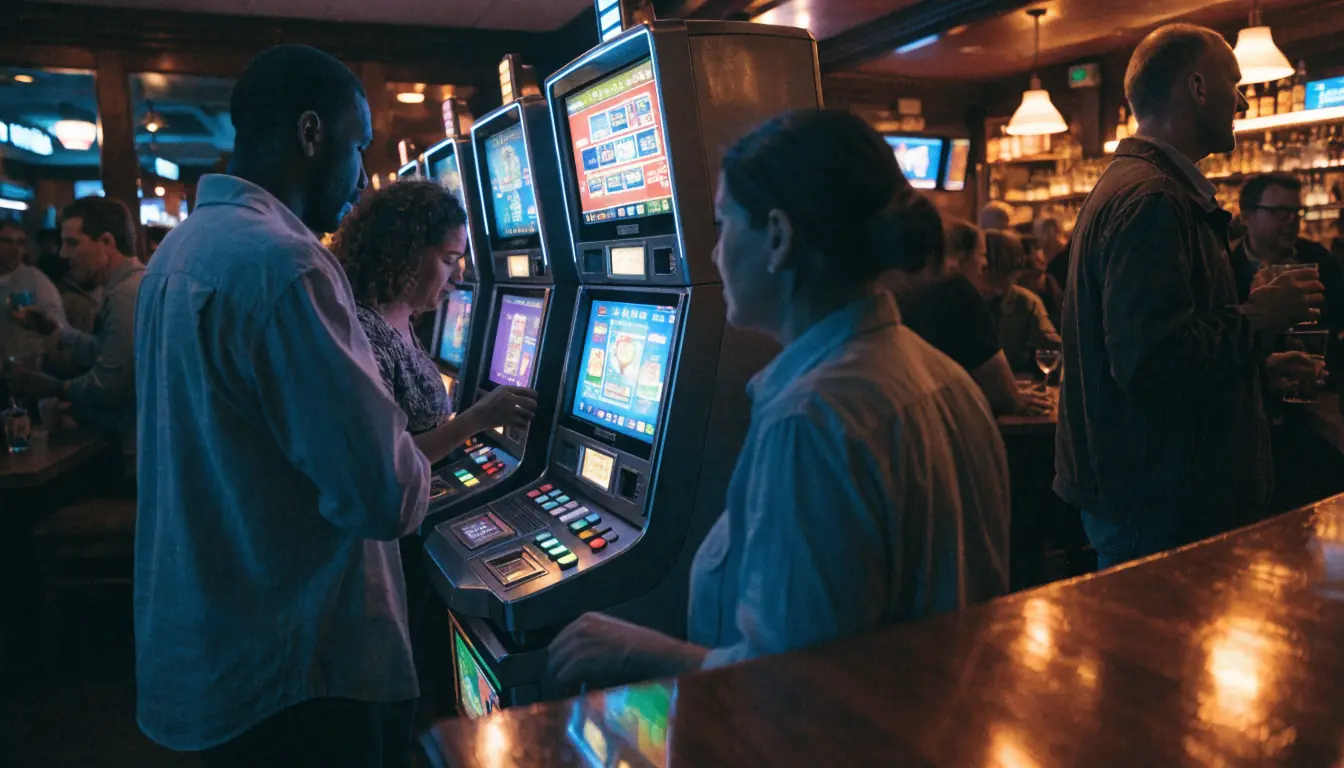

"Convenient" is the word that gets used a lot in this space. What it tends to mean, underneath the marketing, is "cash-like, but through a screen" — and cash-like is exactly the property regulators are trying to design out of the system, not preserve.
E‑Wallet Pokies with No‑Deposit Bonus: What You Need to Know
An e-wallet pokies no deposit bonus is a search that promises more than the law here can deliver. Real-money online pokies for Australian residents are not a legal product, regardless of which payment method funds the account. The Interactive Gambling Act 2001 makes it an offence for an operator to offer this kind of real-money gambling to people in Australia. It doesn’t matter if the wallet is e-wallet based, card based, or anything else. The payment rail isn’t the problem — the offer itself is.
So when a page advertises a no-deposit spin package "for Australian players," that claim sits outside what any operator here is permitted to provide. No local licence exists to make it lawful, and no e-wallet integration changes that.
One detail worth keeping straight: winnings aren’t taxed in Australia. That’s true regardless of the game or the payment method — but it’s a fact about tax treatment, not a green light on legality. People sometimes fold the two together, as if "you keep what you win" implies "the game is fine." It doesn’t.
What is the proposed timeline for implementing the gambling advertising ban in Australia?
Yes — the 2022 NSW Islington Report recommended that all NSW pokies be cashless by the end of 2028. That is the only concrete timeline given in the available material.
How can I verify if a gambling operator is legal?
Yes, you can check several things. Operators with up to 15 pokies must be registered with AUSTRAC, keep identification records and submit suspicious matter reports; larger operators must appoint a compliance officer, run AML/CFT programs and report cash transactions over AUD 10,000. Note that no Australian licence exists for real-money online pokies, since the Interactive Gambling Act 2001 makes it an offence for operators to offer them to residents.
What are the key limits on providing services to customers?
Yes, the key limits are the AUSTRAC rules: venues with up to 15 pokies must register with AUSTRAC, keep ID records and file suspicious matter reports, while venues with more than 15 must also run AML/CFT programs, perform customer due diligence and report cash transactions over AUD 10,000. NSW casino operators can additionally be fined up to AUD 100 million for compliance failures under the amended Casino Control Act 1992.
Created by the ”Casino Security Info” editorial team.