
Casino Dice Games in Australia: Legal Landscape Explained

Table of Contents
- Online Casino Dice Games in Australia – Legal Landscape
- Dice Game Varieties Offered by Australian Land‑Based Casinos
- How to Play Casino Dice Games Online Safely
- Understanding the Core Casino Dice Game
- Craps and Other Dice Table Games Explained
- Casino Games That Incorporate Dice
- What Is a Dice Game in a Casino Context?
- Basic Rules of Casino Dice Games
- Live Dealer Dice Games – Availability and Restrictions
- Where You Can Find a Dice Table in Australian Casinos
Online Casino Dice Games in Australia – Legal Landscape
Ask five people which law bans online casino dice games in Australia and you’ll get five different answers, half of them citing the wrong year. Some sources point to the Interactive Gambling Act 1997, others to the 2001 version. Both names circulate, and I won’t pretend to settle which one is technically correct — the sources themselves disagree. What matters for anyone rolling virtual dice from a phone in Sydney or Perth is what the law actually does, not what year is stamped on the cover.
What it does is straightforward: it prohibits providing online casino games to Australian residents. Slots, poker, blackjack, roulette — and by extension, dice games running on random number generators — all fall under that prohibition. Not because dice games are singled out. They’re not mentioned by name anywhere. They’re caught by the same net as everything else classified as an online casino game.
The part that surprises people: the ban targets operators, not players
This is where the "legal landscape" stops being scary and starts being administrative. The law makes it illegal to offer online casino gambling to Australians. It does not make it illegal for an individual Australian to sit down and play at an offshore-licensed site. No domestic operator can legally run one — there’s no licence to apply for, no application form, no path to compliance for a company wanting to host casino dice games on Australian soil. That door is closed, permanently, by design.
Before trying your luck at dice games online, it helps to know which platforms offer fair licensing, workable bonuses and dependable payouts so you can focus on the game itself.
License: Curacao · Bonus: up to A$2,000 Holds a Curacao license and offers a bonus of up to A$2,000, giving newcomers a decent cushion to explore the dice tables.
Bonus: 100% up to A$750 + 200 free spins, 35x wagering · Payout speed: crypto 30-120 minutes, fiat 24-72 hours · Min. deposit: A$30 Backs its 100% match bonus of up to A$750 plus 200 free spins with fast crypto payouts of 30-120 minutes, while fiat withdrawals take 24-72 hours; a low A$30 minimum deposit keeps entry accessible.
License: Curacao eGaming (Roby Games Ltd) · Bonus: 100% up to A$750 + 200 free spins Licensed under Curacao eGaming via Roby Games Ltd, it pairs this with a 100% bonus up to A$750 plus 200 free spins for new players.
License: Curacao Gaming Control Board · Bonus: up to A$5,000 + 400 free spins Regulated by the Curacao Gaming Control Board, with a sizeable welcome package of up to A$5,000 plus 400 free spins.
License: Curacao Gaming Authority (Jumpman Gaming Ltd) · Bonus: up to A$6,600 + up to 250 free spins across 4 deposits Operating under a Curacao Gaming Authority license via Jumpman Gaming Ltd, it spreads a bonus of up to A$6,600 plus up to 250 free spins across four deposits.
License: Curacao eGaming OGL/2023/174/0082 (Dama N.V.) · Bonus: up to A$10,000 + 500 free spins across 4 deposits · Min. deposit: A$15 Licensed by Curacao eGaming under Dama N.V., it offers a substantial bonus of up to A$10,000 with 500 free spins across four deposits, and a low A$15 minimum deposit makes it easy to start.
License: Curacao, operated by Dama N.V. · Bonus: 325% up to 5.25 BTC + 250 free spins across 4 deposits Operated by Dama N.V. under a Curacao license, it stands out with a crypto-focused bonus of 325% up to 5.25 BTC plus 250 free spins spread over four deposits.
License: Curacao Gaming Control Board OGL/2023/176/0095 (Hollycorn N.V.) · Bonus: up to A$11,000 + 300 free spins (code NEO100) Licensed by the Curacao Gaming Control Board via Hollycorn N.V., it offers a bonus of up to A$11,000 plus 300 free spins redeemable with a bonus code.
License: Curacao Gaming Control Board OGL/2023/176/0095 (Hollycorn N.V.) · Bonus: up to A$5,000 + 300 free spins across 4 deposits Also licensed by the Curacao Gaming Control Board through Hollycorn N.V., it provides a bonus of up to A$5,000 plus 300 free spins spread across four deposits.
License: Curacao (operating since 2017) · Bonus: 250% up to A$2,000 + 50 free spins on the first of six deposits · Min. deposit: A$20 A long-running Curacao-licensed operator since 2017, offering a 250% bonus up to A$2,000 plus 50 free spins on the first of six deposits, with a A$20 minimum deposit.
But the player on the other side of the screen isn’t the one the statute is aimed at. I’ve seen this misunderstood constantly, usually by people assuming that because something is banned, using it must also be banned. That’s not how this particular law is built. The target is the business offering the game, not the person clicking the button.
No single regulator, no single rulebook
Here’s the thing rarely explained plainly: Australia doesn’t have one gambling authority sitting at the top handing down uniform rules. There’s no equivalent of a single national gambling commission that licenses everything from pokies to dice tables to sports wagering under one roof. Regulation is split — federal law sets the outer boundary of what’s prohibited, while each state and territory runs its own regulator for the gambling that happens within its own borders.
That split matters more than it sounds. It means:
- Federal level — the Australian Communications and Media Authority (ACMA) enforces the Interactive Gambling Act against operators offering prohibited services, wherever those operators happen to be based.
- State and territory level — each jurisdiction licenses and polices its own land-based venues, wagering products, and lottery operations, with its own regulator and its own enforcement style.
Nobody sits above both layers reconciling them. A "random number game" — house edge and all — can be legal as a licensed product in one context and prohibited outright in another, depending on whether it’s delivered online to a resident or offered inside a licensed venue.
Who actually does the enforcing
ACMA is the name most associated with online gambling enforcement, and for good reason — it’s the body that acts on the Interactive Gambling Act. But it doesn’t operate alone, and it isn’t the only regulator worth knowing.
The Northern Territory Racing Commission (NTRC) occupies an odd but important position. It’s not federal, and its formal remit is the Northern Territory. In practice, though, it licenses most of the national online bookmakers, largely because operators find the tax arrangement there more favourable than elsewhere. That’s made the NTRC something close to Australia’s de-facto online gambling regulator for the betting sector — not by legal design, but by where the licensing traffic actually flows.
Victoria runs its own body, the Victorian Gambling and Casino Control Commission (VGCCC), which monitors wagering service providers for compliance with the National Consumer Protection Framework — and it does this even for providers based in other states. So a bookmaker licensed in the Northern Territory can still find itself under Victorian scrutiny if it’s taking bets from Victorian residents. Overlapping jurisdiction, not a shared rulebook.
No Domestic Licence
Australian regulators cannot issue a licence for online casino dice games, meaning any site offering them operates without local regulatory approval.
Every other state and territory has its own regulator running its own land-based licensing regime, separate again from anything ACMA does online. None of these bodies issues licences for online casino dice games. That market segment simply isn’t licensable domestically — not through ACMA, not through the NTRC, not through any state commission. The "regulated online casino" doesn’t exist as a category here, no matter which regulator you ask.
What this actually means for someone looking at a dice table online
Strip away the layers and the practical picture is this: no Australian company can legally run an online casino dice game for Australian players, and no regulator — state, territory, or federal — can license one into existence. What exists instead is an offshore market, operating under licences issued by regulators in other countries, serving Australian players who are not themselves breaking any law by using it.
That’s an odd kind of legal landscape — a market that’s simultaneously unregulatable from within and untouchable from without, at least where the player is concerned. Enforcement pressure, where it exists, lands on the operators and the infrastructure around them, not on the person rolling the dice. Understanding that distinction is the difference between reading the Interactive Gambling Act as a blanket prohibition and reading it as what it actually is: a law with a very specific target.
None of this makes offshore play "safe" in the sense that a domestic licence would imply consumer protections backed by an Australian regulator — because there is no such licence to point to, and no Australian body standing behind those platforms. The federal and state regulators mentioned above police what falls within their reach. What sits offshore, by design, falls outside it.

Dice Game Varieties Offered by Australian Land‑Based Casinos
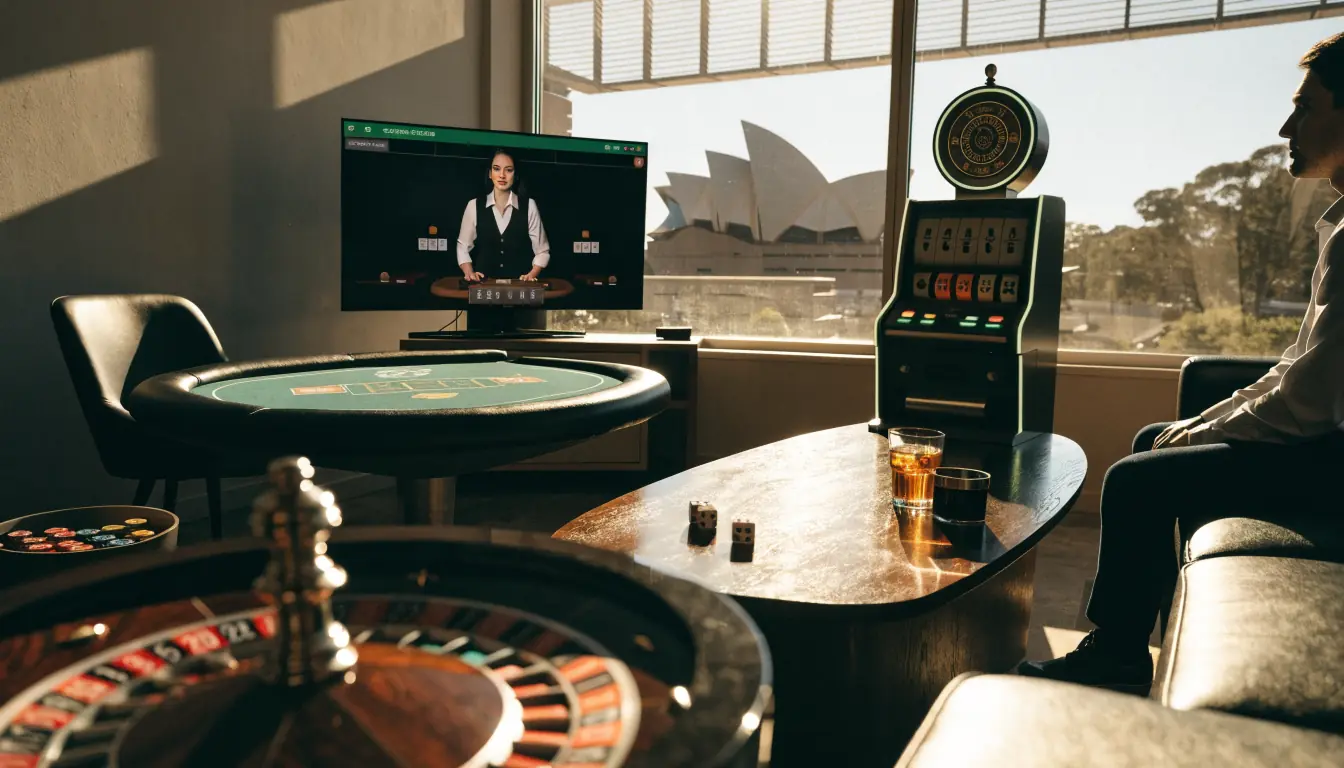
Walk onto the floor of any Australian casino and the dice pit sits apart from the pokies rows — different noise, different crowd, different rhythm. It’s the one corner of the building where the Interactive Gambling Act 2001 doesn’t apply at all. That law governs what’s delivered over the internet to Australian residents; a physical table on a licensed floor in Sydney or the Gold Coast is a different regulatory animal entirely, answerable to state authorities, not Canberra.
That distinction matters more than it sounds. Land-based casinos operate under state government regulators and law enforcement agencies — the bodies that license the venue, vet the equipment, and put inspectors on the floor. It’s a separate system from the one that polices offshore websites. A croupier running a dice table in a licensed venue is working inside a framework built specifically for bricks-and-mortar gaming; nothing about the IGA reaches into that room.
Craps — the anchor game
Craps is the game most people picture when they think of dice at a casino. It’s the loudest table, usually, and the one with the most moving parts — a shooter, a stickman calling the action, multiple betting zones printed across the felt. Most major Australian casinos that run a table games section will have at least one craps table, though floor space for it tends to be more limited than for blackjack or roulette. I’ve seen venues rotate craps tables depending on demand for the shift — it’s a game that needs a crowd to feel right, and pit managers know it.
Two‑dice game with a shooter, a point system and a wide range of betting options.
Three‑dice game where the dice are shaken in a cup; bets are placed on totals, combos or specific numbers.
Sic Bo
Sic Bo is the other dice game with real staying power on Australian floors, and it runs on a completely different mechanic to craps. Three dice, shaken in a covered container rather than thrown by hand, with players betting on combinations, totals or specific numbers before the box is opened. It reads almost like a numbers game rather than a dice game once you’re at the table — no shooter, no sequence of rolls, just one reveal per round. Casinos with a strong Asian-market customer base tend to give Sic Bo more table space than you’d expect, and it’s often positioned near baccarat rather than near craps.
Smaller and regional variations
Beyond the two anchor games, you’ll come across dice mechanics folded into other formats — some poker-dice style games, occasional promotional tables built around dice as a novelty during events, and dice used as a resolution mechanic in hybrid table games that aren’t purely dice-based. These aren’t fixtures the way craps and Sic Bo are. They come and go with a venue’s floor strategy, and what’s running in Melbourne on a given month won’t necessarily match what’s running in Perth. This is state-by-state territory in the most literal sense — each jurisdiction’s regulator signs off on what a licensed venue can offer, and floor layouts aren’t uniform across the country.
Who actually oversees the pit
| Regulatory layer | What it covers |
|---|---|
| State/territory gambling regulators | Licensing of the physical venue, approval of game rules and equipment, floor compliance |
| Law enforcement agencies | Enforcement action tied to the venue’s operating licence |
| Federal law (Interactive Gambling Act 2001) | Online delivery of gambling services — does not apply to in-person table games |
Bodies like the Victorian Gambling and Casino Control Commission exist to monitor wagering service providers and compliance within their own state’s framework. What’s worth understanding is that this state-level oversight has real teeth on a physical floor — inspectors can walk in, audit a table, review a licence — but that same regulator has no comparable reach once the game moves online and offshore. A state gambling authority can shut down a rigged dice table in a casino it licenses. It can’t do the equivalent to a website hosted outside the country. That gap between what a regulator controls on the floor and what it controls online is the whole reason "regulated" means something different depending on which side of the screen you’re standing on.
Why the variety is narrower than you’d think
Given how many dice game formats exist on paper, Australian floors run a fairly narrow selection in practice. Craps demands a lot of table space and staff for the volume of players it seats, which makes venues cautious about how many tables they dedicate to it. Sic Bo is more space-efficient and suits a different customer base. Everything else tends to be experimental or seasonal rather than permanent. If you’re chasing a specific dice variant beyond those two, calling ahead or checking a venue’s current table list is the more reliable move than assuming it’ll be on the floor — state-level approval processes mean a game available in one jurisdiction isn’t automatically running in another.
Australian land‑based casinos typically only carry two core dice games – craps and sic bo – because state regulators limit the variety that can be licensed.
None of this touches what’s available through an offshore website advertising "casino dice games" to an Australian audience — that’s a different legal question altogether, covered separately. What happens on a licensed floor in a physical casino sits squarely with state regulators, and it’s worth knowing that boundary before assuming the same rules, or the same oversight, carry over once a dice game moves onto a screen.
How to Play Casino Dice Games Online Safely
No domestic operator can legally offer online dice games to Australian residents — that part sits in the legal landscape section above. What’s left is the practical question: if someone is going to play anyway, from a jurisdiction where offshore sites are technically off-limits but individually playing on them isn’t a crime, how do they avoid getting burned along the way.
I’ve watched enough of these platforms come and go to know the pattern. According to iclg.com, as of August 2025 ACMA had blocked 1,296 illegal gambling sites and affiliates since 2019, with 220 services voluntarily leaving the Australian market rather than fight the enforcement. A separate account from theiaga.org puts the exit figure at over 100 services since ACMA started enforcing in 2017 — the numbers don’t line up because they’re counting different things at different times, but the direction is the same. Sites disappear. Sometimes overnight, sometimes with your balance still sitting in the account.

Finding a platform that isn’t about to vanish
"Trusted" is a word every operator uses in its own marketing, which makes it useless as a filter. What actually tells you something is where the licence comes from. Platforms licensed by the Malta Gaming Authority or the UK Gambling Commission answer to a regulator with teeth, even if that regulator has no jurisdiction over Australia itself. A site with no visible licensing information anywhere, or one that names a jurisdiction and then can’t produce a licence number, isn’t cautious — it’s hiding something.
There’s no local register to check any of this against. Australia doesn’t licence online casinos domestically, so there’s no government list to cross-reference a name on. The checking has to happen at the source: the licensor’s own site, not the operator’s claims about it.
VPNs solve less than people think
A VPN changes what an ISP sees, not what the operator’s terms say. If a platform’s terms exclude Australian players, routing around a geo-block doesn’t change the exclusion — it just delays the moment the operator notices, which is usually the moment a withdrawal gets held for review. ACMA’s blocking notices to Australian ISPs are aimed at the connection, not at the account behind it, so a VPN sidesteps the block itself. It does nothing about identity checks the operator runs before releasing money.
VPN Limits
Using a VPN may bypass ISP blocks, but it does not change an operator’s terms that exclude Australian players and offers no protection if the site is shut down.
What actually protects the money
- Verify identity documents before depositing, not after trying to withdraw. Every legitimate operator requires ID for withdrawals eventually; finding out what they need on day one avoids a frozen payout on day thirty.
- Read the wagering terms on any bonus before accepting it, not after. Reputable sites publish these upfront — an operator that only reveals conditions once you’ve asked to cash out isn’t being coy, it’s counting on you not reading.
- Avoid funding play with a credit card. Beyond the obvious debt risk, plenty of card issuers block gambling transactions outright, so the deposit fails at the bank’s end regardless of the site.
- Keep some record of deposits and session history. If a platform disputes a withdrawal or closes without warning, that record is the only leverage left.
- Set a time or spend limit before starting, not while ahead or behind. The moment to decide the ceiling is before the dice are in your hand.
None of this makes an offshore dice table equivalent to a locally regulated product — there isn’t one to compare it to. It just means fewer surprises between placing a bet and trying to get paid.
Understanding the Core Casino Dice Game
Strip away the table felt and the stickman’s patter, and what’s left is a bet on a number that a pair of dice will or won’t produce. That’s the whole engine underneath craps, sic bo, and half the "new" dice titles casinos roll out with different branding. Once you understand the base game, every variant reads as a costume on the same skeleton.
Two dice, six faces each, eleven possible totals from two to twelve. Seven is the most common result because more combinations produce it than any other number — that single fact is why the entire betting structure of dice games is built around seven acting as either the winning number or the one that kills your bet, depending on which side of the table you’re standing on. This isn’t a house secret. It’s just arithmetic that most players never sit down and work through before they start betting.
How the betting actually splits up
Core dice games offer two broad categories of wager:
- Line bets — riding with or against the shooter on the initial roll and the point that follows. These carry the lowest house edge in the game and are what serious players stick to.
- Proposition bets — single-roll wagers on specific numbers or combinations, sitting in the middle of the layout. They pay more when they hit, which is exactly why they’re offered — the higher payout disguises a much steeper house edge underneath.
That gap between line bets and proposition bets is the whole business model in miniature. A casino doesn’t need every bet to be profitable at the same rate. It needs the average bet on the table to be profitable, and proposition wagers do the heavy lifting because they look like the exciting play while quietly costing more per dollar wagered than the boring line bet next to them.
Where the house edge actually sits
Every dice game has a built-in mathematical edge for the house — that’s not a flaw, it’s the reason the game exists commercially. What varies is where that edge is concentrated. Line bets are priced close to even money because they’re the entry point, the bet a new player makes without thinking twice. Proposition bets are priced further from even money because they’re the bet a player makes after they’ve had a few rolls go their way and start feeling confident. The layout is designed to catch that moment.
None of this is hidden information — it’s printed on the felt if you know how to read it — but it’s rarely explained at the table, and nobody’s handing out a breakdown before you place your first chip.
Simple payout
Example: 5 × $10 = $50 payout.
Why this matters more online than it looks
In Australia specifically, this section describes mechanics you’d encounter at a physical table, because online casino dice games — along with poker and in-play betting — are prohibited federally under the Interactive Gambling Act 2001. That prohibition sits on the operator, not the mechanics themselves; the dice don’t change, only where you’re legally allowed to sit down and play them.
It’s also worth knowing that the Australian Communications and Media Authority has, since November 2019, been ordering internet service providers to block offshore sites offering exactly these kinds of games — meaning ACMA can request a site be cut off simply for offering an online casino, online pokies, or in-play sports betting to Australian residents. The mechanics of a dice game don’t stop at a border. The right to offer them for real money online, inside Australia, does.
Understanding the base game — the numbers, the two bet categories, the edge built into each — is what makes every other variant, from craps to sic bo to the dice-adjacent hybrids covered elsewhere, easier to read for what it actually is.
Craps and Other Dice Table Games Explained
Craps is the game most people picture when someone says "dice table." Two dice, a crew of four running the layout, and a betting board that looks intimidating until you realise most of it is variations on the same handful of ideas: will the shooter make their point, or won’t they.

The core sequence is simple. The shooter rolls a "come-out" roll. A seven or eleven on that first roll wins for anyone betting the Pass Line; a two, three, or twelve loses it. Anything else — four, five, six, eight, nine, ten — becomes "the point," and the shooter keeps rolling until that number comes up again (a win) or a seven shows first (a loss for Pass Line bets, a win for the Don’t Pass side). That’s the whole engine. Everything else on the table — Come bets, Field bets, Place bets, the proposition bets clustered in the middle that pay out on a single roll — is built on top of that same seven-versus-the-point logic.
What makes craps different from most table games is the social layer. Everyone at the table is betting on the same shooter’s outcome at the same time, which is part of why it’s had staying power in venues that also run blackjack, roulette, and everything else. A hot shooter turns a table loud in a way a good blackjack hand rarely does.
Related dice games on the floor
Craps isn’t the only dice game you’ll find, though it’s the one with the most betting depth. Sic Bo is the other dice table worth knowing — three dice instead of two, no shooter, no point system. Players bet on combinations, totals, or specific numbers appearing, and the round resolves in one roll rather than a sequence. It’s faster and simpler to learn than craps, which is part of its appeal, but the trade-off is a betting structure with fewer decision points — there’s less for a player to actually influence once the bet is placed.
Craps
A two‑dice casino game where players bet on the outcome of a series of rolls, with a “point” established after the come‑out roll.
Some venues also run simplified dice games under house-branded names, essentially stripped-down craps or Sic Bo variants with a smaller betting board. The mechanics underneath are the same two ideas — sequential point-chasing or single-roll totals — dressed differently for the floor.
On "strategy"
Craps attracts more strategy talk than most casino games, and most of it doesn’t hold up. Betting systems that adjust wager size based on previous rolls don’t change the house edge on any individual bet — the dice have no memory, and the game doesn’t either. What actually varies is which bets on the layout carry a lower house edge than others; Pass Line and Come bets sit toward the better end, while many of the one-roll proposition bets in the middle of the table sit toward the worse end. Knowing that distinction is closer to informed betting than "strategy" — it’s picking the better-priced bets on a board that offers both.
Where this sits legally
None of this changes anything about where you’re allowed to play it. A dice table in a licensed Australian venue is a straightforward, regulated product. A "craps" game on an offshore website is a different animal entirely — outside ACMA’s licensing reach, and outside its ability to do much for a player who has a dispute with the operator. ACMA can investigate an offshore casino site, push for it to be blocked at the internet service provider level, and refer the operators to foreign regulators or border authorities. What it can’t do is get anyone’s money back or arbitrate a disagreement over a payout. That distinction matters more for a slow, betting-heavy game like craps than for something you play in thirty seconds and walk away from.

Casino Games That Incorporate Dice
Not every game with dice on the felt is a dice game in the strict sense. A fair number of slot-style titles and hybrid table products borrow the dice as a random-outcome mechanic, then wrap it in something else entirely — a slot reel, a card-based structure, a board-game theme. The dice becomes a prop for generating a number, not the point of the game.
This matters more online than on a casino floor, because it changes what a platform is allowed to call itself. A game with a dice-roll bonus feature sitting on top of a standard reel set is still, at its core, an online slot. Regulators don’t reclassify a product because it has dice icons in the paytable.
Where the line actually falls
Three broad categories turn up under this heading:
- Slot titles with a dice bonus round — the base game is spins and paylines; dice appear as a feature that triggers multipliers or bonus picks.
- Hybrid table games — variants that combine card mechanics with a dice-determined outcome, sold as a “new twist” on a familiar table game.
- Board-game-adjacent products — titles built around movement or progression, where dice decide how far a player advances rather than a direct win/loss.
None of these change the legal category the product falls into. If it’s delivered as an online casino product to someone in Australia, it sits under the same prohibition as a straight slot or a roulette wheel — the dice theme doesn’t carve out an exception. The Australian Communications and Media Authority can request that a website offering these games be blocked, the same way it acts against online casinos and online slots generally. It has no comparable power over the platforms where these games get advertised — a gambling site can be blocked at the ISP level, but a Facebook ad promoting the same product to an Australian audience sits outside ACMA’s reach, because of how the advertising prohibition is worded.
That gap is worth noticing. It means a hybrid dice-slot can be technically unreachable through a blocked domain while still showing up in someone’s feed. "New," "innovative," "reinvented" — the marketing language around these hybrids tends to lean hard on novelty. What it rarely mentions is that novelty doesn’t move the product into a different regulatory bracket. It’s still an online casino game wearing a different hat.

What Is a Dice Game in a Casino Context?
Ask a pit boss what counts as a dice game and the answer is narrower than most people expect. In the strict sense, a casino dice game is one where dice are the mechanism that decides the outcome — the roll itself is the bet. Craps is the obvious example: two dice, a shooter, and a betting layout built entirely around what those dice show. Nothing else drives the result. No cards, no wheel, no random number generator standing in for a physical throw.
That’s different from a game that merely borrows dice as a supporting element — a side bet, a bonus round, a flourish added to a table game whose core mechanic is something else entirely. I covered that distinction in the previous section, and it matters here too: "dice-based" gets used loosely in marketing copy, applied to anything with a die printed on the felt, when the honest description is closer to "dice-adjacent."
Online dice games remain unregulated domestically
The lack of an Australian licence means offshore dice platforms operate without local consumer protection.
The confusion isn’t accidental. Calling a hybrid product a "dice game" makes it sound simpler and more tactile than it is — closer to something you’d play with friends than a table run on a house edge. The label sells better than the mechanic underneath it.
Under Australian law, this definitional line doesn’t actually change what’s permitted. Whether a title is dice-only or dice-hybrid, it falls under the same category as roulette, blackjack or pokies once it’s offered as a real-money online casino product — and the Interactive Gambling Act 2001 prohibits operators from offering any of those to residents here, regardless of which random number games mechanic sits at the centre. The distinction matters for understanding the game, not for understanding its legal status.
So the working definition, stripped of marketing language:
- Dice-only games — outcome determined solely by a physical or virtual dice roll (craps and its direct variants).
- Dice-hybrid games — dice used as one input among several, layered onto a table game with a different core mechanic.
Both sit under the same regulatory umbrella. Only one of them is actually a dice game.
Basic Rules of Casino Dice Games
Strip away the table dressing and every dice game runs on the same skeleton: a roll produces a number, that number gets compared against a bet, the bet pays or dies. What changes between variants is which numbers count, how many dice are thrown, and what odds the house attaches to each outcome.
The roll itself is the fixed point. Two or more dice, thrown with no way to influence the landing face — that’s what makes these "random number games" rather than games of skill, and it’s the reason payout tables can be calculated in advance rather than adjusted on the fly. A croupier or an automated system reads the combination, settles winning positions, clears losing ones.
Betting structures sit on top of that roll. Most variants offer a layer of simple, close-to-even-money wagers for players who want short odds, alongside a second layer of proposition bets on specific combinations that pay out at longer odds precisely because they land less often. This is where the house edge actually lives — not in the dice, which have no memory and no bias built in, but in the price attached to each bet relative to its true probability.
Limits work the same way they do at any table game: a floor and a ceiling per bet, set by the venue rather than the game itself. What sits between those numbers is a house decision, not a rule of the game.
What stays constant across nearly every variant:
- Outcomes are decided purely by the roll, with no skill component affecting the physical result.
- Payout odds are fixed in advance and published before a wager is placed.
- Bet limits are set per table or per platform, not per game type.
The house edge is baked into the odds themselves — it’s worth remembering that before treating any dice bet as "fair" in the everyday sense of the word.
Live Dealer Dice Games – Availability and Restrictions
Live dealer dice tables exist. A croupier rolls the dice on camera, the feed streams to a browser, and the result gets read out the same way it would across a real table. Technically it’s the closest thing to being on the floor without leaving the couch. Legally, it’s a different question entirely.
Live, in-play online betting is illegal in Australia. That covers wagering placed once a round or event is already underway and streamed in real time — which is precisely what a live dice table is. The one carve-out that survives is live betting placed by phone, a leftover distinction that predates streaming casinos and wasn’t written with dice games in mind.
So a "live dice" table sitting on an offshore site isn’t a grey area someone forgot to regulate — it’s the exact activity the restriction targets. According to industry-tracking sources, dozens of illegal gambling operators have already exited the Australian market since enforcement tightened, and live-streamed table games are the kind of product that draws that attention first.


Land-based dice tables with a real croupier remain the legal version of this experience. Streamed and unregulated, it’s a different bet altogether.
Where You Can Find a Dice Table in Australian Casinos
Dice tables sit on the main gaming floor, usually clustered near roulette and blackjack rather than off in some side room. Land-based casinos across the states carry them as standard table-game inventory, though the exact layout varies by venue.
What doesn’t vary is who’s answerable for the pit. Land-based casinos in Australia are regulated by state government regulators and law enforcement agencies — a separate structure from the federal oversight that applies to online gambling. Each casino floor answers to its own state licensing body, not to a national gambling authority.
Online, the picture is different again. The Victorian Gambling and Casino Control Commission monitors wagering service providers for compliance with the National Consumer Protection Framework, including operators based outside Victoria — but that’s wagering, and it’s a state-level watch, not proof of an online casino licence. No such licence exists domestically.
So the honest answer to "where can I play" splits in two: physical tables, on a licensed floor, under a named state regulator you could actually look up. Anything online sits outside that structure entirely.
No register. No shortcut.
Are crypto casinos legal in Australia in 2026?
It is illegal to offer online casino gambling in Australia, and there is no licence a domestic operator can obtain — this applies to crypto casinos just like any other online casino. However, the law targets operators, not players, so an individual Australian playing at an offshore-licensed crypto casino is not breaking the law. Note that offshore play lacks consumer protections backed by any Australian regulator.
Is it illegal for Australian players to play at offshore online casinos?
No, the Interactive Gambling Act targets the operators providing online casino games to Australians, not individual players. You are not breaking any law by playing at an offshore-licensed site, though you also have no Australian regulator backing you if something goes wrong.
Who regulates online gambling in Australia?
There is no single national gambling authority. ACMA enforces the Interactive Gambling Act at the federal level against offshore operators, while each state and territory runs its own regulator for land-based venues, wagering and lotteries. The Northern Territory Racing Commission also acts as a de-facto regulator for most national online bookmakers.
Can I complain to a regulator about an offshore casino?
ACMA can investigate and block prohibited interactive gambling services, but it cannot recover funds or settle individual disputes with offshore operators. State regulators like the VGCCC and Liquor & Gaming NSW likewise have limited power over offshore online casinos, so there is no Australian body that will get your money back.